How to win at Catan-style games: a strategy guide
To win at Catan-style games, place your first settlements on high-pip corners (6, 8, 5 and 9) that touch different resources, commit to a roads-and-settlements or a cities-and-cards plan, keep your hand under 8 cards before a 7, and use harbors and trades to turn spare cards into points.
Which numbers are best? Count the pips
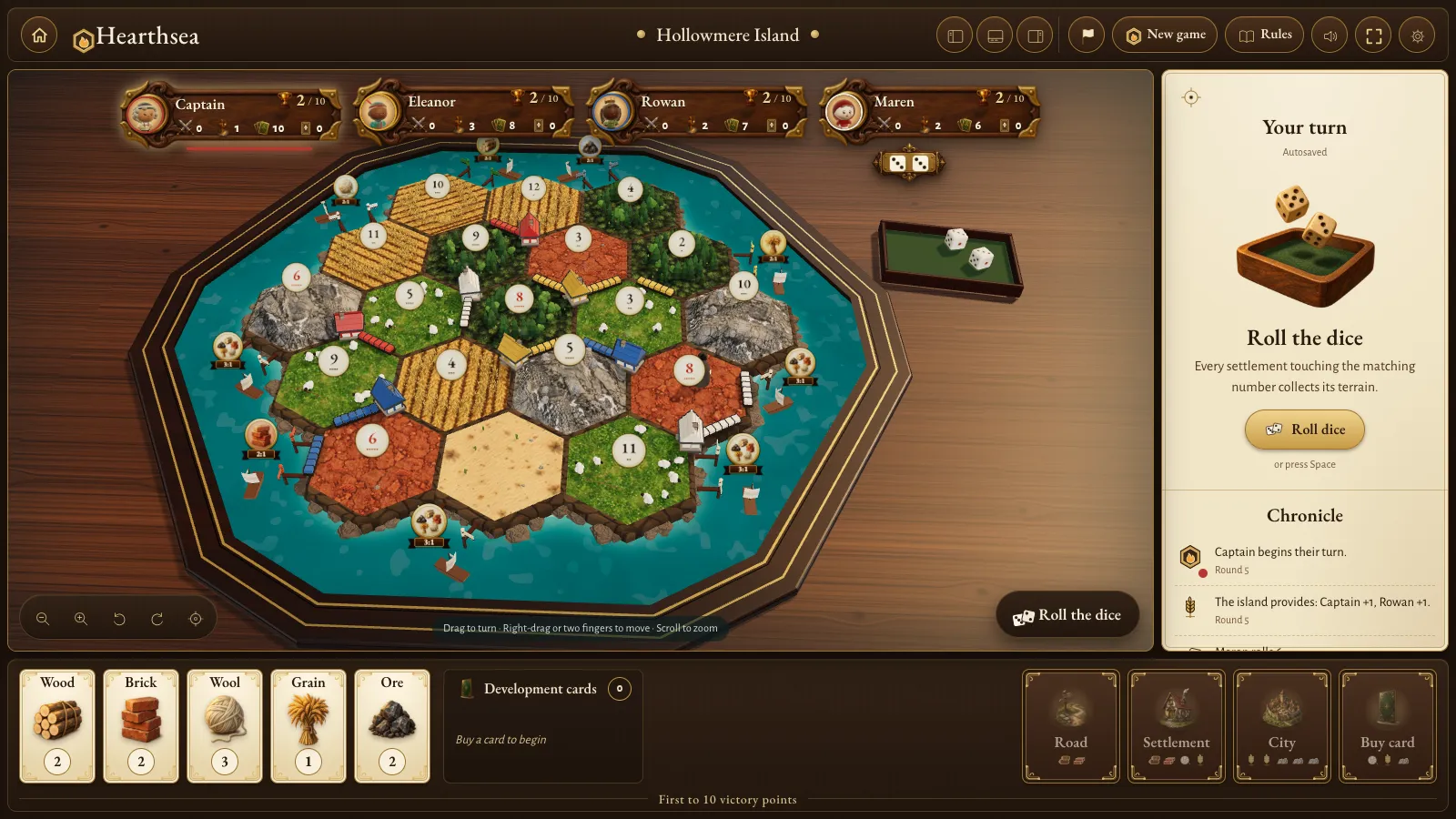
6 and 8 are the best numbers in Catan-style games: each comes up 5 times in 36 rolls, about 14% of the time, while 2 and 12 come up once in 36.
The dots under each number token, called pips, count those chances. A 6 has five pips, a 5 has four, a 4 has three, and so on. Add the pips of the hexes around a corner and you have that corner’s production: the number of cards a settlement there collects, on average, every 36 rolls.
| Number | Ways out of 36 | Chance per roll | Pips on the token |
|---|---|---|---|
| 2 or 12 | 1 | 2.8% | 1 |
| 3 or 11 | 2 | 5.6% | 2 |
| 4 or 10 | 3 | 8.3% | 3 |
| 5 or 9 | 4 | 11.1% | 4 |
| 6 or 8 | 5 | 13.9% | 5 |
| 7 | 6 | 16.7% | none: the robber moves |
A worked example: a corner touching a 6, an 8 and a 5 has 5 + 5 + 4 = 14 pips. In a four-player game every player rolls once a round, so that settlement collects about 14 ÷ 36 × 4 ≈ 1.6 cards per round. A corner on 2, 12 and 3 has 4 pips and collects about 0.4. Over a 15-round game that gap is roughly 17 cards, about four settlements’ worth of resources.
Two cautions. Pips are averages, and a short game can run hot or cold. And a hex with the robber on it produces nothing, so the best hex on the board is also the robber’s favourite target.
Where to place your first two settlements
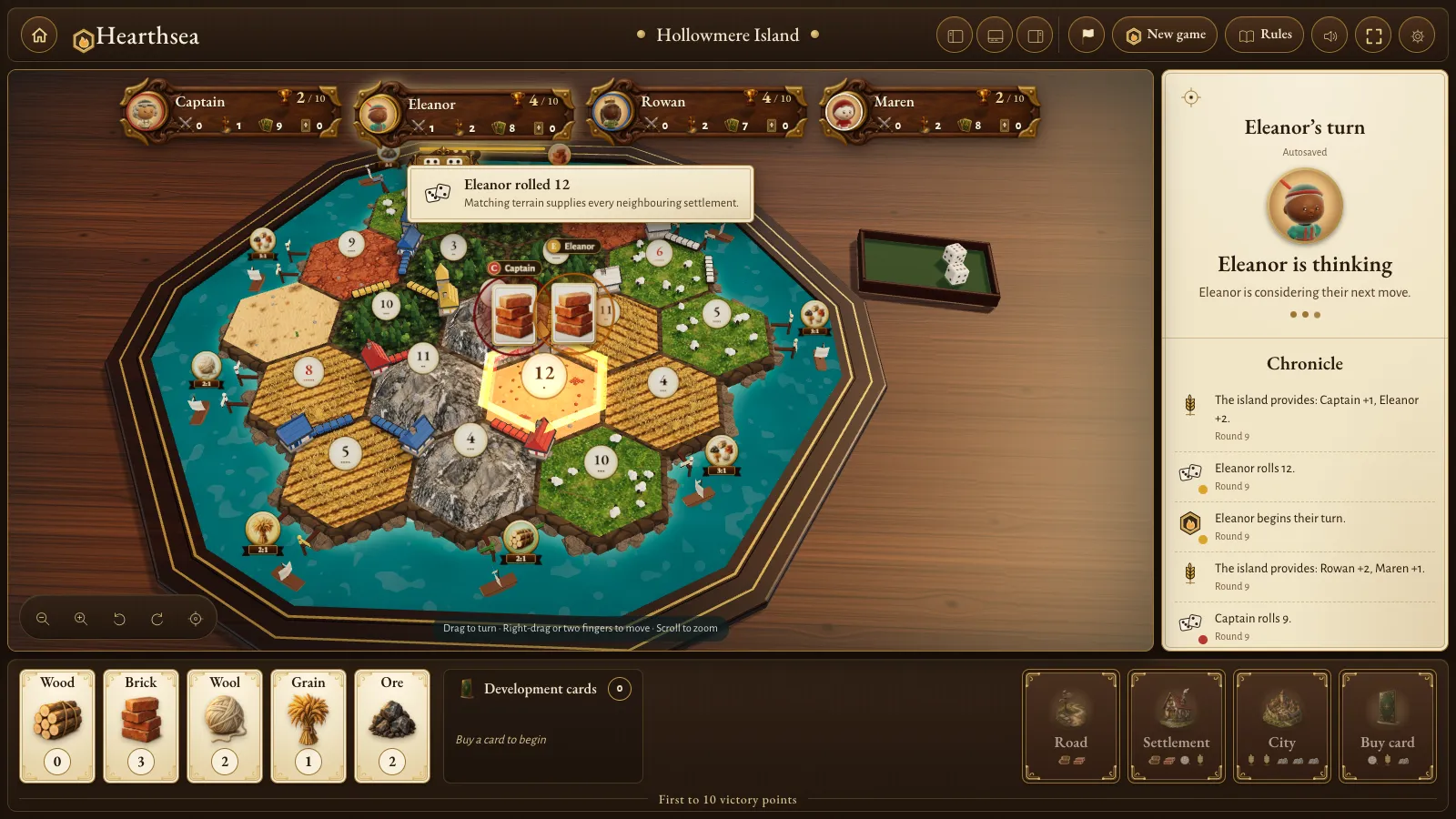
The opening decides more games than any later move. Weigh four things for each corner.
- Total pips. Aim for 11 or more on each starting settlement.
- Resource spread. Three different resources beat two hexes of the same one. You cannot build without trading if you are missing two of the five.
- Scarcity. Before placing, add up the pips for each resource across the whole board. If ore has 9 pips and wood has 20, an ore corner is worth more than its number suggests.
- Room to grow. Point your first road at the next good corner, not at the coast. Under the distance rule a settlement blocks the three corners next to it, so check that a rival cannot cut you off in one move.
Your second settlement collects one card from each hex it touches as soon as it is placed. Use it to fill the gaps in your first: if your first corner has wood and brick, a second corner with ore and grain gives you every resource from the opening round.
Pick a plan: roads and settlements, or cities and cards
Most winning games follow one of two plans, set by the resources your opening produces.
| Build | Cost | Points |
|---|---|---|
| Road | 1 wood, 1 brick | 0, but counts toward Longest Road |
| Settlement | 1 wood, 1 brick, 1 wool, 1 grain | 1 |
| City | 2 grain, 3 ore | +1 (2 in total), and doubles that corner’s production |
| Development card | 1 wool, 1 grain, 1 ore | 1 in 5 is a victory point |
The expansion plan (wood and brick)
Build roads toward open corners and drop settlements early. It is strong on a crowded board, where the good corners go fast, and it puts Longest Road within reach. Its weakness comes late: once your 5 settlements are down or the corners run out, wood and brick lose value unless a harbor turns them into something else.
The city plan (ore, grain and wool)
Upgrade to cities and buy development cards. A city costs 5 cards and doubles a corner’s production, so the plan snowballs. Knights from the deck also build toward Largest Army. Its weakness is the start: you may go several turns without building while you save up ore.
You do not have to commit on turn one, but by your third or fourth turn your hand should be clearly feeding one plan.
Harbors: when a 2:1 or 3:1 trade pays off
The bank trades 4 of one resource for 1 of any other. A 3:1 harbor improves that for every resource, and a 2:1 harbor makes one named resource as good as currency.
A 2:1 harbor is worth a settlement when you produce plenty of its resource, about 8 pips or more. A wool harbor next to your two 6-wool pastures turns every wool roll into half of anything you need. Without that production, the harbor is a slow corner.
A 3:1 harbor suits a hand that produces a bit of everything and runs short on one thing at a time. It also takes the sting out of a blocked trade: when nobody will deal with you, the harbor still will.
The robber and the 7: hold fewer than 8 cards
A 7 is the single most likely roll. When it comes up, every player holding more than 7 cards discards half, rounded down, and the roller moves the robber and steals a card.
The chance of a 7 is 1 in 6 on any roll. In a four-player game, the chance that at least one 7 is rolled before your next turn is 1 − (5/6)4 ≈ 52%. So ending your turn with 8 or more cards is close to a coin flip on losing half of them. Spend down, trade down, or buy a development card before you pass the dice.
When you move the robber, put it on the hex that costs the leader the most: their best number and a resource they need. Avoid hexes where your own settlement sits, and remember that a knight card lets you move it on your own turn without waiting for a 7.
Longest Road and Largest Army: two points each
Longest Road goes to the first player with an unbroken road of at least 5 segments, and moves whenever someone builds a longer one. Branches don’t count, and a rival settlement built in the middle of your road splits it. Largest Army goes to the first player to play 3 knights, and moves to anyone who plays more.
The development deck holds 25 cards: 14 knights, 5 victory points, and 2 each of road building, year of plenty and monopoly. So each card you buy has a 56% chance of being a knight. Three or four cards usually bring Largest Army within range.
Both titles swing four points between two players when they change hands: the holder loses two and the taker gains two. Watch them in the last few rounds: a late Longest Road can win a game from behind.
How to trade well
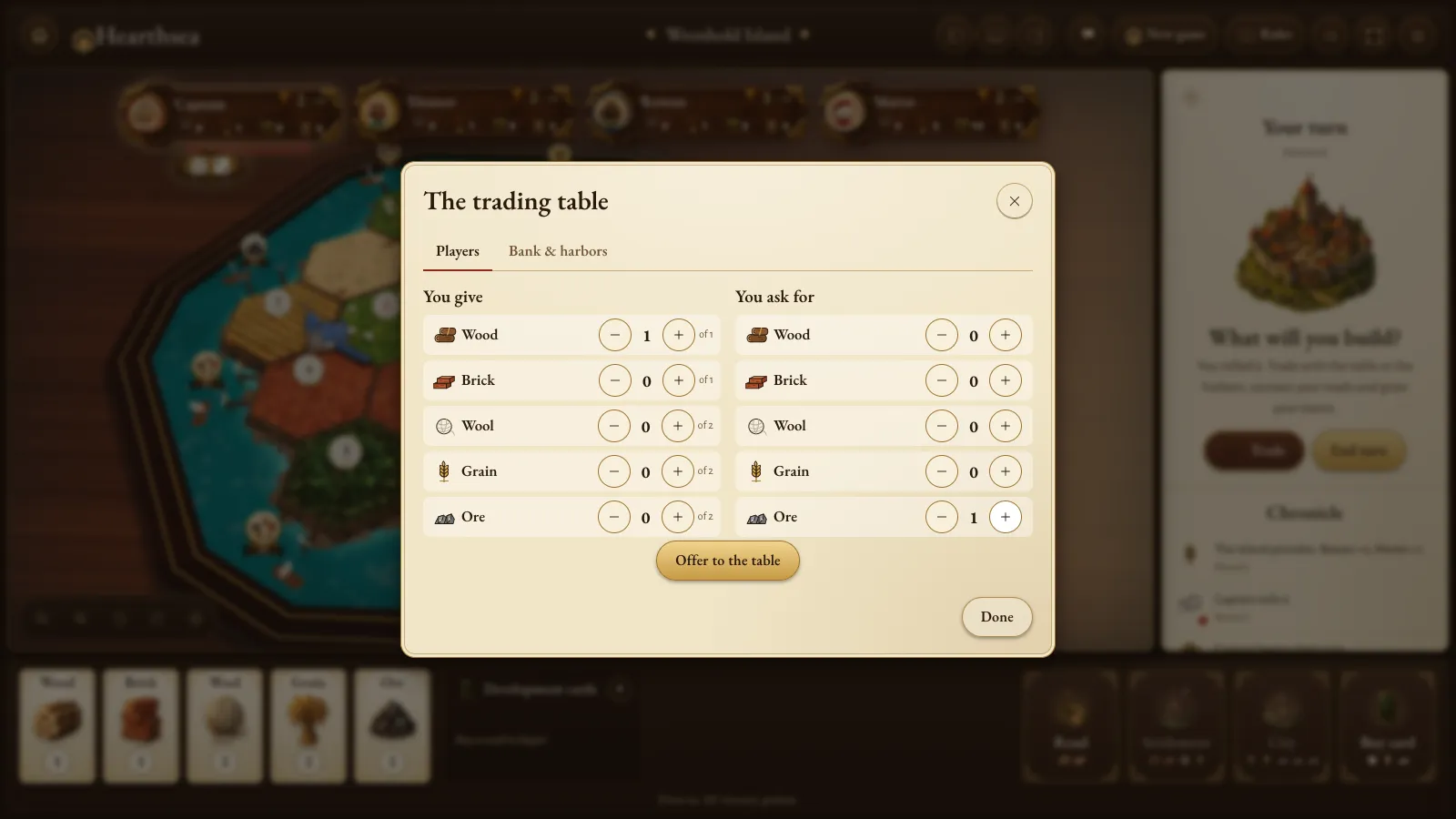
- Trade when the deal lets you build this turn. A card that sits in your hand can be stolen or discarded.
- Ask for two-for-one when you hold something scarce. If nobody else produces ore, ore is worth more than one card.
- Do not trade with the leader in the last third of the game unless the trade wins it for you.
- Count what the others are missing. A player who has not rolled their brick number in five turns will pay well for brick.
Closing out the game
In the last few turns, count every player’s visible points and assume each unrevealed development card might be a victory point. Victory point cards stay hidden and count the moment they would win you the game.
Plan the turn you win. You only win on your own turn, so if you will reach the target with a city and Longest Road, gather both sets of cards and do it in one go rather than revealing your plan a turn early.
Practise against bots that play this way
Hearthsea’s Veteran bot plays most of this guide: it weighs scarce resources and harbor fit, places its second settlement to complement its first, spends down before a 7 and races for Longest Road and Largest Army. Losing to it a few times is the quickest way to learn the openings. Our guide to playing against AI bots sets out a practice ladder from Settler to Veteran.
Seafarers maps change the opening math, since a settlement on a new island is worth 2 bonus points. That is covered in Seafarers maps explained. For the full rules, see how to play Hearthsea.
Questions people ask
What are the best numbers in Catan?
6 and 8. Each is rolled 5 times in 36, about 13.9% of rolls, and 5 and 9 come next at 11.1%. 7 is the most common roll at 16.7%, but it produces nothing and moves the robber instead.
Where should I place my first settlement?
On a corner with 11 or more pips that touches three different resources, ideally including the resource that is scarcest on that board. Leave room for your first road to reach another good corner.
Is an ore and grain city strategy good?
It is strong when your opening produces ore and grain well. Cities double a corner’s production and development cards build toward Largest Army, but the plan starts slowly while you save five cards for each city.
How many cards should I hold before a 7?
Seven or fewer. With more than 7 you discard half when a 7 is rolled, and in a four-player game the chance of a 7 before your next turn is about 52%.
Should I go for Longest Road?
Go for it when your opening produces wood and brick and the board has open space. It is worth 2 points but can be taken from you, so it matters most in the last few rounds.
Sources
Facts about Hearthsea come from the game itself and its rules and pricing pages. Facts about other games come from their own websites. All were checked on 6 October 2026.
- Hearthsea rules: dice odds, building costs, development deck
- Probabilities are computed from the 36 equally likely outcomes of two six-sided dice.
Keep reading
Try it on a real table
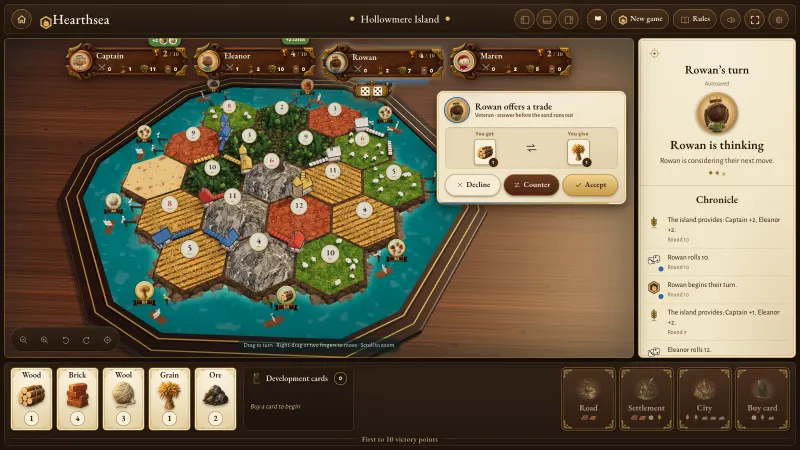
Make a free account and play against bots on the Standard and Balanced maps. Hearthsea Pass adds online games with friends, from $5 a month.
CATAN is a registered trademark of Catan GmbH. Hearthsea is an independent game and is not affiliated with, endorsed by or sponsored by Catan GmbH or its publishers. Other game names belong to their owners and are used here only to describe and compare.