Cities & Knights rules: everything that changes from the base game
Cities & Knights adds an event die, a barbarian ship and knights to the base game. You start with a settlement and a city and race to 13 points. Cities on forest, pasture and mountains also give paper, cloth or coin, which buy city improvements, metropolises and progress cards. Every few turns the barbarians land: if the awake knights are weaker than the island’s cities, the player who defended least loses a city.

Setup: a settlement, then a city
The first change comes before anyone rolls.
Each player places a settlement and a road, then, in reverse order, a city and a road. The city pays one resource for each hex it touches, the way the second settlement does in the base game. The target is 13 points on a standard map. City walls, knights, metropolises and the barbarians all start empty.
The roll: two dice and the event die
Every roll throws three dice: the red and yellow production dice, which work as usual, and the event die. Three of its six faces show a ship; the other three show a gate in the colour of a track: science, trade or politics.
- A ship moves the barbarians one space closer.
- A gate lets every player with an improvement in that colour draw a progress card of that colour, if the red die is low enough: level 1 draws on a red 1 or 2, level 2 up to 3, and so on, up to level 5, which draws on any red die.

Commodities: paper, cloth and coin
A city on forest gives one wood and one paper. On pasture, one wool and one cloth. On mountains, one ore and one coin. Cities on hills and fields still give two of their resource. Settlements never make commodities.
Commodities count as cards in your hand, so they count toward a 7, and they trade like resources with other players. With the bank they go 4:1, or 3:1 at a 3:1 harbor, never at a resource’s own 2:1 harbor. The Merchant Guild makes them 2:1.
City improvements and metropolises
Each track has five levels, bought with its own commodity: paper for science, cloth for trade, coin for politics. A level costs as many commodities as its number: one for the first, five for the last. You need at least one city to build an improvement.
| Track | Paid with | Level 3 ability |
|---|---|---|
| Science | Paper | Aqueduct: when a roll other than 7 gives you nothing, take one resource of your choice |
| Trade | Cloth | Merchant Guild: trade two of the same commodity for any one card |
| Politics | Coin | Fortress: promote strong knights to mighty |
The first player to reach level 4 on a track raises its metropolis on one of their cities. It is worth 2 points on top of the city and can’t be sacked by the barbarians. Someone who reaches level 5 first takes it away; the first to level 5 keeps it for good.
Knights: recruit, wake, promote
- Recruit a basic knight for one wool and one ore, on a corner joined to your roads. It starts asleep.
- Wake it for one grain. A knight woken this turn can act from your next turn.
- Promote it for one wool and one ore: basic to strong, and strong to mighty once you have the Fortress. You hold at most two of each strength.
An awake knight can move along your roads, push a weaker rival knight off its corner, or chase the robber off a hex it touches. Each of these puts it back to sleep. Strength is what counts against the barbarians: a basic knight is worth 1, a strong one 2, a mighty one 3.
The barbarians attack
The ship lands on the seventh space. Its strength is the number of cities and metropolises on the island, everyone’s together. The island’s defence is the strength of every awake knight, everyone’s together.
- If the knights hold, the player who gave the most strength alone becomes Defender of the island, worth a point. If several tie for most, each draws a progress card instead.
- If the barbarians win, of the players who still have an ordinary city, the one or ones who gave the least strength each lose one. It goes back to a settlement, walls and all. Metropolises are safe.
Either way every knight goes to sleep and the ship goes back to the start. The first attack also brings the robber onto the island: until then a 7 makes players discard, but the robber doesn’t move.
City walls and the hand limit
A wall costs two brick and goes under one of your cities. Each wall raises the number of cards you may hold on a 7 by two, from 7 to 9, 11 and 13 with three walls, which is the most you may build. If the barbarians sack a walled city, the wall goes with it.
Progress cards
The 54 progress cards come in three decks of 18. You may hold four, apart from the two victory-point cards, Printing and Constitution, which are laid face up at once. You play them on your turn after the roll; Alchemy, which sets the production dice, is the one you play before rolling.

The merchant
The Merchant progress card puts the merchant on a land hex beside one of your buildings. While he stands there you trade that hex’s resource 2:1, and he is worth a point to whoever placed him last.
Rules groups argue about
- Does a 7 do anything before the first attack? Players still discard, but the robber stays off the island.
- Do metropolises count for the barbarians? Yes, as cities. They just can’t be sacked.
- Can a knight act the turn it is woken? No, from your next turn.
- Do commodities count toward a 7? Yes. They are cards in your hand.
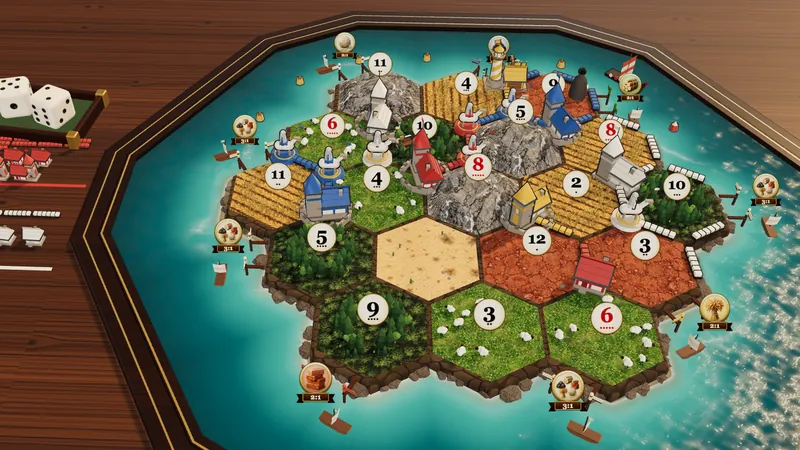
In Hearthsea the table enforces all of these, and the Chronicle records every roll, attack and card, so nobody has to look anything up.
Questions people ask
How many points do you need to win Cities & Knights?
13 on a standard map. Hearthsea’s Seafarers islands ask for two points above the map’s own target.
What happens when the barbarians win?
Of the players who still have an ordinary city, the one or ones who gave the least knight strength each lose one, which goes back to a settlement. Metropolises can’t be sacked.
When can the robber move in Cities & Knights?
Only after the first barbarian attack. Before that a 7 still makes players with too many cards discard, but the robber stays put.
How many progress cards can you hold?
Four, not counting the victory-point cards Printing and Constitution, which are laid face up as soon as they are drawn.
What does the aqueduct do?
The Aqueduct, level 3 of science, gives you one resource of your choice whenever a roll other than 7 gives you nothing.
Sources
The rules here follow the 2025 sixth-edition rulebook and FAQ from catan.com, and Hearthsea’s own rules engine. Checked on 15 October 2026.
Keep reading
 Play Cities & Knights online, free
 Cities & Knights strategy: tracks, knights and timing
 We simulated 10,000 games of Cities & Knights
Let the table keep the rules
Cities & Knights is free on every Hearthsea account, today and after the free month: it was never behind a pass. The table counts the barbarians, the knights and the commodities for you.
Cities & Knights is free on every Hearthsea account, today and after the free month: it was never behind a pass. The table counts the barbarians, the knights and the commodities for you, and every other mode is free right now too.
CATAN is a registered trademark of Catan GmbH. Hearthsea is an independent game and is not affiliated with, endorsed by or sponsored by Catan GmbH or its publishers. Other game names belong to their owners and are used here only to describe and compare.