Balanced dice vs real dice: what a million rolls show
Balanced dice replace two dice with a shuffled deck of all 36 results, so over a game each total comes up close to its true odds. In our simulation of a million rolls they halved how far a game’s numbers strayed from the odds, from 14.5% to 7.4%, and no game went short of 6s and 8s. But across 3,000 bot games each way, the player with the best starting spots won just as often: 33.4% with real dice, 32.8% with balanced ones.

The odds of every number
Two dice make 36 equally likely results. Everything about which numbers to build on comes from counting them.
A 7 can be made six ways, so it comes up once every six rolls. A 6 or an 8 can be made five ways each, a 2 or a 12 only one. The dots under a number token count those ways: five dots on a 6 means five chances in 36.
Why real dice feel unfair
A game lasts about 70 rolls; ours averaged 68 with four players. That is too few for the odds to even out. Over 70 rolls a 7 should come up about 11.7 times, but with real dice it came up anywhere from 1 to 26 times in our simulation. One game in 74 gave the 6s and 8s less than 60% of their share, which leaves whoever built on them waiting all evening.
That is the feeling behind every “these dice are rigged” post. Nothing is rigged: short runs of fair dice are lumpy.
How balanced dice work
Balanced dice swap the dice for a deck: one card for each of the 36 results, shuffled. Each roll draws a card. Over 36 rolls every result comes up exactly once, so a 7 can’t vanish for half the game, and a 6 can’t turn up ten times in a row.
A plain deck has one weakness: near the end you can count what is left and know the next roll. Hearthsea reshuffles the whole deck when five or fewer cards remain, so the last rolls before a reshuffle are never certain. Physical dice decks and some other sites work differently; we describe only ours here.
What a million rolls show
We rolled a million times each way, real dice and the balanced deck, built exactly as the game builds it, and cut the rolls into 14,285 games of 70.
| Measure | Real dice | Balanced dice |
|---|---|---|
| Sevens in a 70-roll game, typical range | 1–26 | 5–18 |
| Spread of sevens per game (standard deviation) | 3.1 | 1.6 |
| How far a game’s numbers stray from the odds | 14.5% | 7.4% |
| Games where 6s and 8s come up at under 60% of the odds | 1.3% | 0.0% |
| Games with a run of 15 rolls without a 7 | 54% | 44% |
The balanced deck halves how far a game’s numbers stray from the odds and almost halves the spread of sevens. It doesn’t remove long waits for a 7: draws without a 7 can still run for 15 rolls, just less often.
Do balanced dice change who wins?
Then we played real games. Four Veteran bots, the Standard map, 3,000 games with real dice and 3,000 with balanced ones, the same seeds for the island and the bots each way. We counted the pips each player’s two starting settlements touched, then checked who won.
| Measure | Real dice | Balanced dice |
|---|---|---|
| The player with the most starting pips wins | 33.4% | 32.8% |
| Average game length | 17.2 rounds | 17.2 rounds |
| Rolls per game | 68 | 68 |
The best start won about a third of the time either way, against roughly one in four if starting spots didn’t matter. The difference between the two columns is smaller than the noise in 3,000 games. Balanced dice make a single game feel fairer, because nobody’s numbers go missing for an hour, but over many games they didn’t make the strongest opening win more often.
The bots play the same way whatever the dice. People may not: knowing the 8 will come round could change how you trade.
How to turn them on
In Hearthsea, open the table settings when you set up a solo game or a room and set Dice to Balanced. Every roll of that game, and the chart of rolls at the end, uses the deck. Random, two fair dice, stays the default.
Questions people ask
What are balanced dice in Catan?
A deck of the 36 possible two-dice results, shuffled and drawn one at a time instead of rolling. Over a game each total comes up close to its true odds.
How often is a 7 rolled?
One roll in six on average, about 11 or 12 times in a 70-roll game. With real dice a single game can see far fewer or far more.
Do balanced dice make the game fairer?
They make each game’s rolls fairer: in our simulation they halved how far the numbers strayed from the odds. They didn’t make the best starting position win more often: 33.4% with real dice against 32.8% with balanced ones.
Are online dice rigged?
Not on sites that roll fair dice: short runs of fair dice are simply lumpy. In our million-roll simulation a 70-roll game saw anywhere from 1 to 26 sevens.
Can you count the deck to know the next roll?
With a plain deck, near the end. Hearthsea reshuffles when five or fewer cards remain, so the next roll is never certain.
Sources
The numbers come from our own simulation, run on 15 October 2026 with Hearthsea’s rules engine; the script is the one the game uses for its dice. Background on dice odds and decks:
Keep reading
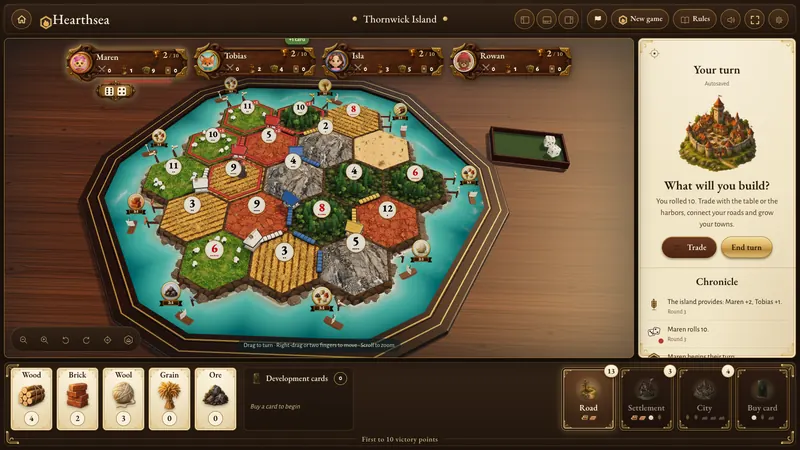 Balanced boards, fair setups and starting spots
 We simulated 10,000 games of Cities & Knights
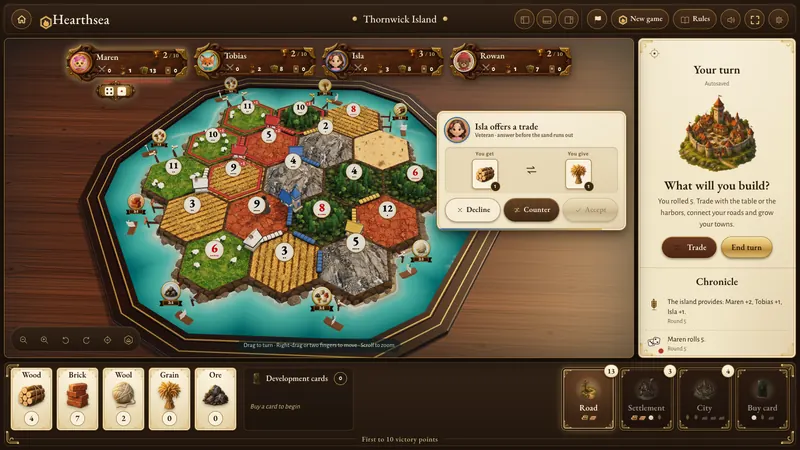 Play a Catan-style game against AI bots
Try balanced dice yourself
Make a free account, set Dice to Balanced at the table, and see whether your 8 comes round.
Every mode and map is free right now. Set Dice to Balanced at the table and see whether your 8 comes round.
CATAN is a registered trademark of Catan GmbH. Hearthsea is an independent game and is not affiliated with, endorsed by or sponsored by Catan GmbH or its publishers. Other game names belong to their owners and are used here only to describe and compare.