Balanced Catan boards: fair setups and starting spots
A balanced Catan board keeps the red 6s and 8s apart, which the official rules require on a random board. It also spreads each resource across good and poor numbers, avoids a single corner that out-produces the rest, and gives every seat a fair start through the snake-order placement in the rules.

Can 6 and 8 be next to each other in Catan?
Not on a random board. The CATAN rulebook says that with a fully random setup “the tokens with the red numbers must not be next to each other,” and that you may have to swap tokens until no red numbers sit on adjacent hexes.
The red numbers are 6 and 8, the totals two dice roll most often after 7. Each comes up 5 times in 36 rolls. Put two of them side by side and the corner between them collects on 10 of every 36 rolls from those two hexes alone, before you count the third hex. Whoever gets that corner in setup tends to run away with the early game.
The rule has a neat side effect. The three hexes around a corner all touch one another, so once reds are kept apart, no corner can touch two of them. The richest corner possible is then one red number plus two 4-pip numbers (a 5 or 9), which comes to 13 pips. On a board without the rule, a corner touching two 6s and an 8 could reach 15.
This post is about the board itself. Where to put your own settlements once the board is down is the subject of our strategy guide.
What makes a Catan board fair?
The red rule is the only fairness check in the official rules. Board generators and careful groups add a few more. Here is what each one catches.
| Check | What to look for | What it prevents |
|---|---|---|
| Red numbers apart | No 6 or 8 touching another 6 or 8 (official rule) | One corner that out-produces the board |
| No twin numbers touching | Two 9s, two 5s and so on on neighbouring hexes | A pair of hexes that pays the same corner twice on one roll |
| Every resource gets a fair number | Add the pips of each resource’s hexes; none should sit on 2s, 3s and 12s alone | A resource so scarce that one player can corner it |
| No runaway corner | The best corner is not far ahead of the second, third and fourth best | The first pick deciding the game |
| Harbors within reach | Each 2:1 harbor sits near at least some of its resource | Harbors nobody can use |
A board does not have to pass every check to be playable, and a lopsided board can make an interesting game. The checks matter most when players of different experience sit at the same table, because a hidden imbalance rewards whoever spots it.
Pips: how to measure a corner
Pips are the dots under each number token. They count the ways two dice make that number out of 36: five for 6 and 8, four for 5 and 9, three for 4 and 10, two for 3 and 11, one for 2 and 12. Add the pips of the hexes around a corner and you have its production per 36 rolls.
The standard board’s 18 tokens hold 58 pips in total, about 3.2 a hex and 11.6 for each of the five resources. That gives you a quick test. Add the pips for one resource across the board; if ore has 6 and grain has 18, the board is lopsided, and the ore corners are worth more than their numbers suggest. Our strategy guide explains how to use pip counts when you pick your first two settlements.
Should 2 and 12 touch? Should two of one resource touch?
Neither is against the rules, and both are matters of taste. A 2 and a 12 side by side make a weak corner (2 pips between them), so it wastes one area of the board without favouring anyone. Some groups like that, because it pushes everyone toward the same few good corners.
Two hexes of the same resource touching is more of a fairness problem. If both ore hexes meet at one corner and both carry good numbers, the player who settles there controls the ore supply, and ore buys cities and development cards. If you would rather avoid that, swap one of the two hexes with a different terrain before the numbers go down.
Harbors work the same way. A 2:1 ore harbor next to the only good ore is a strong spot for one player; a 2:1 harbor on the far side of the island from its resource is worth little to anyone.
How do you make a fair random board?
The rulebook’s variable setup gets you most of the way. These steps follow it, then add the checks above.
- Turn the terrain hexes face down, shuffle them and lay them out at random.
- Place the harbor pieces at random on the frame, if your edition has them.
- Lay the number tokens. The rulebook’s method places them letter side up in alphabetical order, starting at a corner and spiralling counterclockwise toward the centre, skipping the desert. For a fully random board, place them in any order and swap until no red numbers touch.
- Swap any twin numbers that sit side by side.
- Add up each resource’s pips. If one resource has only poor numbers, trade one of its tokens with a richer token on a resource that has plenty.
- Find the two or three best corners. If one stands far above the rest, swap a token next to it.
- Roll for the starting player and place in snake order, as the rules describe.
Steps 4 to 6 take a couple of minutes once you are used to them. If you would rather skip them, an online board generator does the same work, and so does any digital version with a balanced map option.

Is the beginner board balanced?
The rulebook says so. Of its Starting Set-up for Beginners it writes: “This set-up is well-balanced for all players.” The layout is fixed, the number tokens are fixed, and each colour’s two starting settlements and roads are printed on the setup diagram, so nobody gains from a better first pick.
The same rulebook recommends moving on: “It is more fun to play with a variable game board.” The fixed board stops being fair in a different way once some players have played it many times and others have not, because the regulars know which colour’s position they like. After the first few games, a random board with the checks above is the better choice.
Does going first matter in Catan?
Less than it looks, because setup runs in snake order. In the first round each player places a settlement and a road, clockwise from the starting player. In the second round the order reverses: the player who went last places first, and the starting player places their second settlement last. Each player collects starting resources from the hexes around their second settlement.
So the first player gets the best corner on the board but the last pick of the second round. The last player gets two settlements in a row, which lets them plan a pair that fits together. The starting player then rolls first. On a board with a runaway corner, first pick is a real advantage, which is one more reason to run the fairness checks.
In the rules, the player who rolls highest goes first. Hearthsea can draw lots for it instead.
What are balanced dice?
Balanced dice replace two random dice with a deck of all 36 possible results, shuffled. Each roll draws one, so over a game the totals come out close to their true odds: a 6 shows up about five times per 36 rolls instead of streaking or vanishing. You can still roll a 7 three turns in a row; it is just less likely to happen all game.
In Hearthsea it is a table setting called Balanced dice, and the deck is reshuffled before it runs out, so the last few rolls can’t be counted. Balanced dice suit groups who find a long dry spell on a good number more frustrating than exciting. They make the board’s numbers more reliable, which also means an unfair board stays reliably unfair.
Try a balanced board in Hearthsea
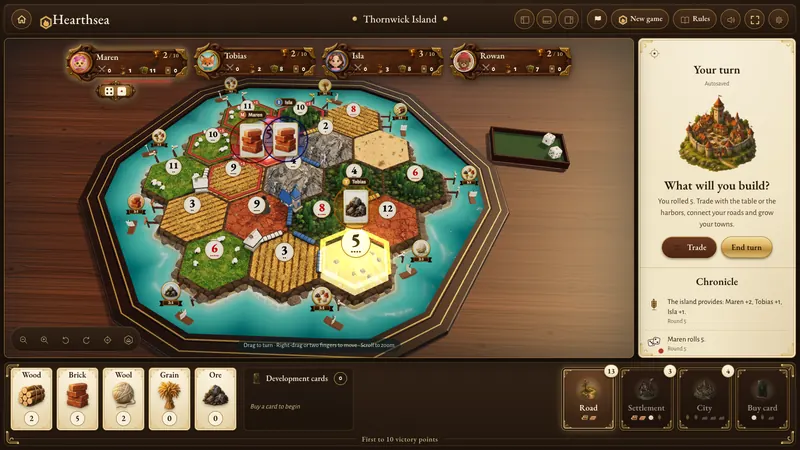
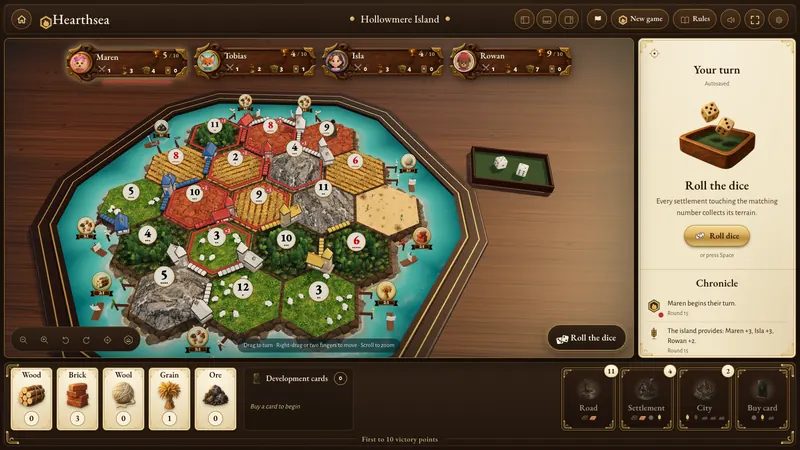
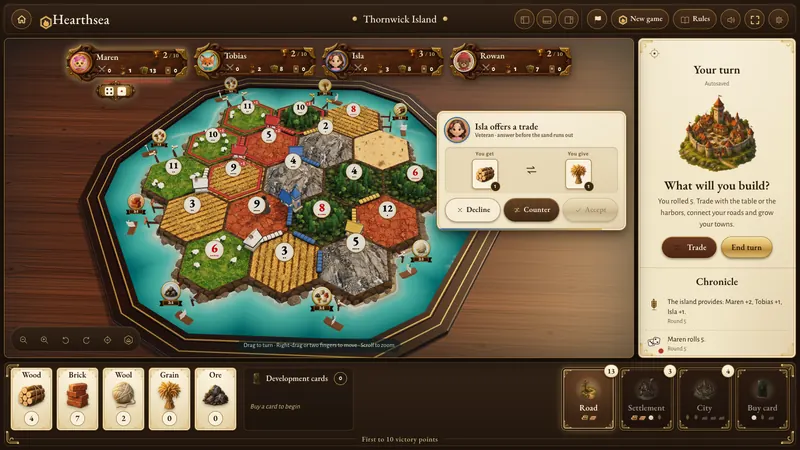
Hearthsea is our game, an independent Catan-style game not affiliated with CATAN GmbH, so take this as a description of how we built it. Its Classic mode has a map called Balanced: “Dealt at random, then evened out so every resource and every corner gets a fair share.” In practice the game deals a board and only keeps it if it passes these checks:
- No 6 or 8 touches another 6 or 8, and no number touches its twin.
- Each resource’s hexes average between 2.3 and 4.4 pips per hex, so no resource is starved or flooded.
- No corner adds up to more than 12 pips.
It tries up to 400 deals to find one. The Standard map is dealt at random too, with sixes and eights never touching. On top of the map you can set balanced dice, a friendly robber that leaves alone anyone on 2 points or fewer, and random player starts, where lots are drawn for who places first. Setup runs in snake order as in the rules above.
The Balanced map is one of the four maps a free account can play, alongside Standard, the Seafarers island New Shores and the Highlands map The Peaks, against bots or pass-and-play.
The full rules are on our rules page, and if you want opponents for practice, our post on the three bot levels explains how each one plays.
Questions people ask
Can 6 and 8 be next to each other in Catan?
Not on a random board. The CATAN rules say that with a fully random setup the tokens with the red numbers, the 6s and 8s, must not be next to each other, and that you may have to swap tokens until no red numbers sit on adjacent hexes.
What is the most balanced Catan setup?
The rulebook calls its Starting Set-up for Beginners well balanced for all players. For a random board, the fairest setups keep 6s and 8s apart, keep each number off its twin, give every resource at least one good number and avoid any corner worth much more than the others.
Does going first matter in Catan?
It matters less than it seems, because setup runs in snake order. The first player picks the first corner but places their second settlement last, while the last player places two settlements in a row. The starting player then takes the first roll.
What are pips in Catan?
Pips are the dots under each number token. They count the ways two dice can roll that number out of 36: five for a 6 or 8, four for a 5 or 9, down to one for a 2 or 12. Adding the pips around a corner tells you how much a settlement there will produce.
What are balanced dice?
Balanced dice replace two random dice with a shuffled deck of all 36 possible results. Each roll draws from the deck, so over a game each total comes up close to its true odds and long streaks of one number become unlikely. Hearthsea offers them as a table setting.
Sources
The setup rules quoted here come from the CATAN base game rules and almanac published on catan.com, read on 11 October 2026. Facts about Hearthsea’s maps and settings come from the game itself and its rules page.
Keep reading
Play a board that has already been checked
Make a free account, pick the Balanced map and play against three bots that trade. No setup, no swapping tokens.
CATAN is a registered trademark of Catan GmbH. Hearthsea is an independent game and is not affiliated with, endorsed by or sponsored by Catan GmbH or its publishers. Rulebook passages are quoted only to explain the official rules.