The Catan-style rules most groups get wrong
The rules most groups get wrong in Catan-style games are small ones. You discard only when you hold more than 7 cards. Only the player whose turn it is may trade. A development card can’t be played on the turn you buy it. A harbor works only for the player with a settlement on it. And when someone ties for Longest Road, the card stays with whoever already holds it.

Setting up: only the second settlement pays
Most rules arguments come from a handful of small rules, and the first one turns up before anyone rolls.
In the setup, each player places a settlement and a road, then everyone places a second settlement and road in reverse order. Only the second settlement pays out at once: you take one card for each hex it touches. The first earns nothing until the dice say so.
Two more setup rules get missed. The distance rule applies from the start, so no settlement may sit on a corner next to another settlement, your own included. And each starting road has to touch the settlement you just placed.
In Hearthsea the game lights up only legal corners and edges. On Seafarers maps a starting corner may not touch a gold field, and either starting road can be a ship instead.
Your turn: roll first, then trade and build in any order
The published rules have you roll before anything else. After the roll you can trade and build in any order. The rulebook recommends that experienced players ignore its separate trade and build phases, so you can build a settlement on a harbor and use the harbor on the same turn.
The one thing allowed before the roll is a development card. The classic use is a knight: move the robber off your own best hex, then roll. In a three- or four-player game you can’t build or trade on anyone else’s turn. Five- and six-player games add a paired build phase, which the five- and six-player guide explains.
Trading: only with the player whose turn it is
- Only the player whose turn it is can trade with others. Two players who aren’t on turn can’t trade with each other.
- No gifts. Both sides must give at least one card, and you can’t swap matching resources, such as 3 ore for 1 ore.
- Development cards can’t be traded or given away.
- A harbor works only for the player with a settlement or city on one of its two corners. A 2:1 harbor improves that one resource only; it doesn’t give you 3:1 on the others.
- The 4:1 bank trade is always open on your turn, harbor or not.
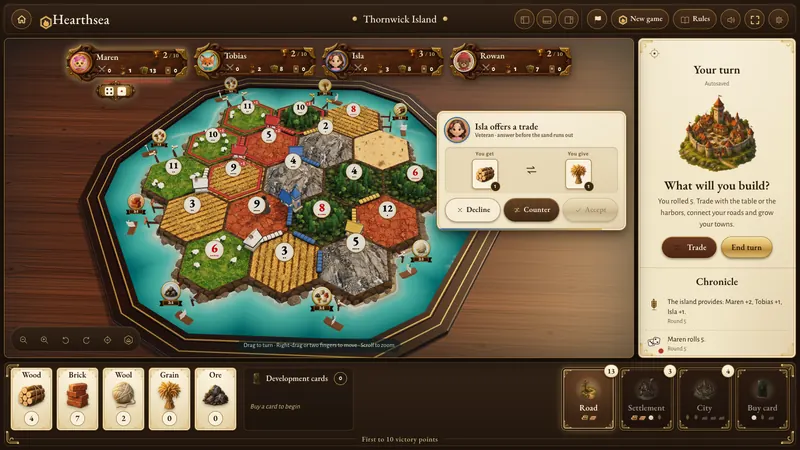
Hearthsea refuses gifts and like-for-like swaps with a message, and the bank panel shows each player their own harbor rates.

Rolling a 7: who discards, and how many
You discard only when you hold more than 7 cards, and then you give up half, rounded down.
| Cards in hand | Discard |
|---|---|
| 7 or fewer | 0 |
| 8 or 9 | 4 |
| 10 or 11 | 5 |
| 12 or 13 | 6 |
Then the roller must move the robber to a different hex. Any land hex counts, the desert included, so the robber can go back there later. The roller steals one random card from one player with a settlement or city on that hex, and gets nothing from a player with no cards.
In Hearthsea the limit is a table setting from 5 to 12, with 7 as the default. On Seafarers maps the roller can move the pirate instead and rob a ship.
Development cards: one a turn, never the one you just bought
You can buy as many development cards as you can pay for. You can play only one per turn, and never one you bought that turn. You can play it at any point in your turn, including before you roll.
Victory point cards work differently. You never play them: they stay hidden and count toward your total, and they can win you the game on the turn you buy them. Hearthsea counts them for you and ends the game the moment your total reaches the target.
Longest Road and Largest Army: the tie rules
Longest Road goes to the first player with an unbroken road of at least 5 segments. Forks don’t count, and a rival’s settlement on a corner in the middle of your road splits it in two.
Ties are where tables go wrong. A player who only ties the holder doesn’t take the card; they need a longer road. If the holder’s road is broken and two or more others tie for longest, the card is set aside until one road is longer than the rest. The same happens when nobody has 5 segments left.
Largest Army goes to the first player with 3 knights played, and to take it from them you need strictly more. Hearthsea follows both rules. On Seafarers maps, roads and ships count together toward the longest trade route where your own settlement or city joins them.
When the bank runs out
The published game has 19 cards of each resource. If a roll owes more of one resource than the bank holds, nobody gets any of it that turn, unless only one player is owed, who then takes what is left.
Hearthsea’s bank never runs out, so that shortage never comes up and nobody has to count the stacks.
Winning: only on your own turn
You win when you reach the target on your own turn, counting hidden victory point cards. If points come to you on someone else’s turn, say because a rival broke the Longest Road and it passed to you, you wait until your turn to claim the win.
Hearthsea checks your score whenever you act and at the start of your turn. In five- and six-player games your paired build phase counts too: reach the target there and you win at once.
House rules that are table settings in Hearthsea
Some popular house rules are built in as table settings, so the whole table sees them before the game starts. All of these are free:
- Friendly robber: the robber leaves alone anyone showing 2 points or fewer.
- Balanced dice: rolls come from a shuffled set of all 36 results, so streaks even out.
- Discard limit: anywhere from 5 to 12 cards.
- Points to win: any target from 5 to 25.
- Pieces: how many roads, settlements and cities each player has, from 2 to 10 settlements, for example.
- Turn timer: 60, 90 or 120 seconds a turn, or off.
Map size and fog come with any pass. The full list is on the rules page.
Let the table keep the rules
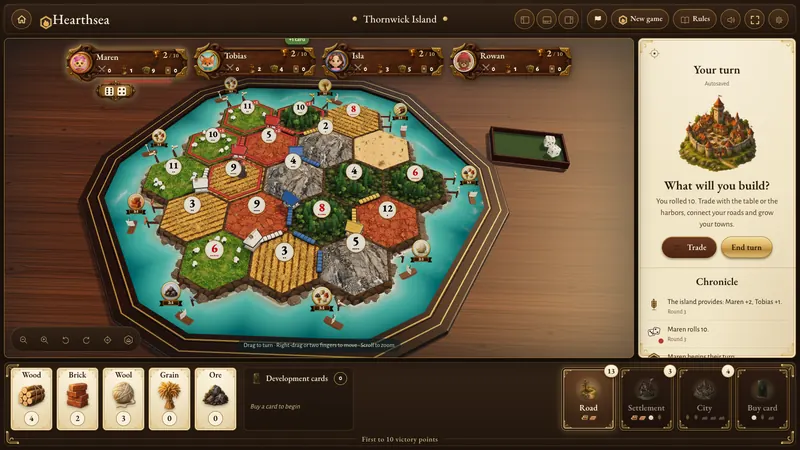
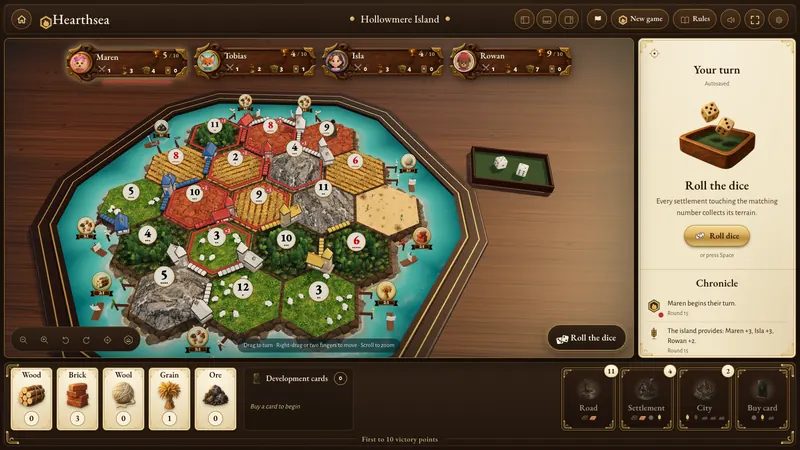
Most of these arguments disappear when the table enforces the rules. In Hearthsea you can’t trade before you roll, play a card you just bought or use a harbor you don’t touch, and every roll, trade and steal goes into the Chronicle for anyone who wants to check. If your group keeps stopping to look things up, play a game there and see which rules you had been playing differently. Our strategy guide is the next step once the rules are settled.
Questions people ask
Can you trade before you roll in Catan?
No. You roll first, then trade and build in any order. The only thing allowed before the roll is playing one development card, such as a knight.
Do you discard on a 7 if you have exactly 7 cards?
No. Only players holding more than 7 cards discard, and they give up half, rounded down: 8 or 9 cards means discarding 4.
Can you play a development card the turn you buy it?
No, apart from victory point cards, which are never played and count as soon as you have them. You may play one development card per turn, at any time in the turn, before the roll included.
Who keeps Longest Road on a tie?
The player who already holds it. Another player has to build a longer road to take it. If the holder’s road is broken and others tie, the card is set aside until one road is longest.
Can the robber go back to the desert?
Yes. The robber must move to a different hex each time, but any land hex is allowed, the desert included.
Sources
Facts about Hearthsea come from the game itself and its rules and pricing pages. Facts about other games come from their publishers and the sources below. All were checked on 8 October 2026.
Keep reading
Play with the rules built in
Make a free account and play against bots or pass-and-play on the Standard and Balanced maps, the Seafarers island New Shores or the Highlands map The Peaks, 3 games a day. A pass adds every map of its mode and online games with friends, from $3.99 a month.
CATAN is a registered trademark of Catan GmbH. Hearthsea is an independent game and is not affiliated with, endorsed by or sponsored by Catan GmbH or its publishers. Other game names belong to their owners and are used here only to describe and compare.