Catan numbers: pips, odds and why 6 and 8 are red
The dots under a Catan number, called pips, count the ways two dice can roll it out of 36. A 6 or an 8 has 5 pips, so each comes up about once every 7 rolls; that is why they are printed in red. The deck has 25 development cards, 14 of them knights, and each player has 5 settlements, 4 cities and 15 roads.

What the dots under the numbers mean
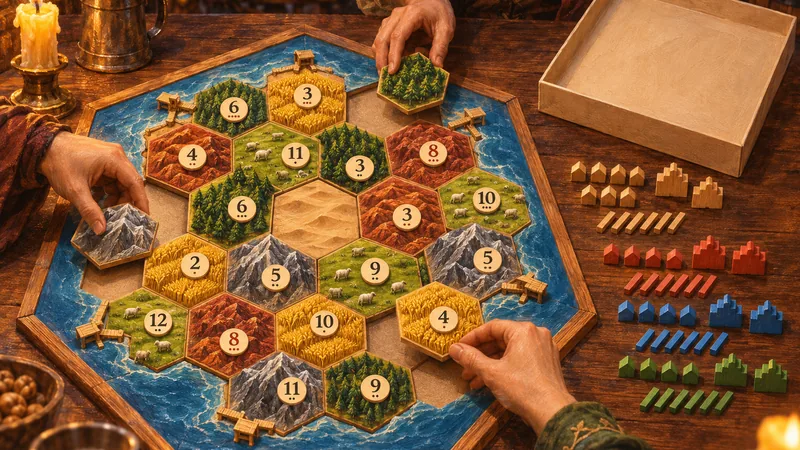
Count the dots. That one habit fixes most bad opening placements, and it takes a second per number.
Two dice give 36 equally likely results. A number’s dots, or pips, tell you how many of those 36 roll it: one dot for the 2 and the 12, five for the 6 and the 8. Add up the pips of the three hexes around a corner and you have that corner’s expected output. A corner on 6, 5 and 9 has 13 pips; a corner on 2, 3 and 11 has 5.
The odds of every number
| Number | Pips | Chance per roll | About once every |
|---|---|---|---|
| 2 | 1 | 2.8% | 36.0 rolls |
| 3 | 2 | 5.6% | 18.0 rolls |
| 4 | 3 | 8.3% | 12.0 rolls |
| 5 | 4 | 11.1% | 9.0 rolls |
| 6 | 5 | 13.9% | 7.2 rolls |
| 7 | 6 | 16.7% | 6 rolls (the robber) |
| 8 | 5 | 13.9% | 7.2 rolls |
| 9 | 4 | 11.1% | 9.0 rolls |
| 10 | 3 | 8.3% | 12.0 rolls |
| 11 | 2 | 5.6% | 18.0 rolls |
| 12 | 1 | 2.8% | 36.0 rolls |
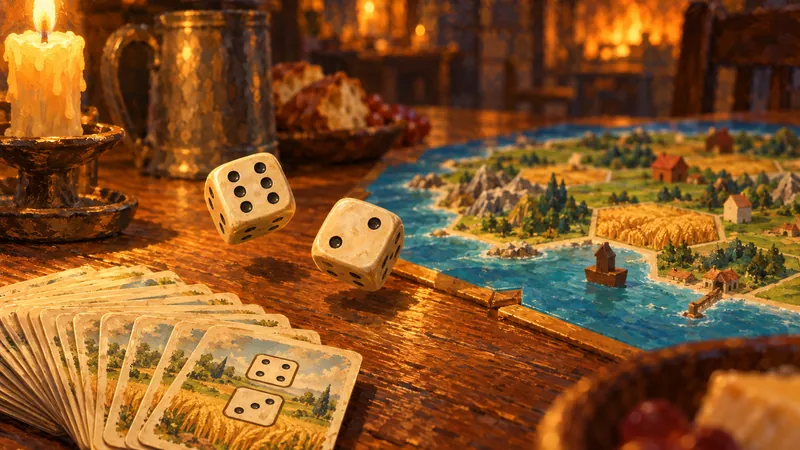
A 4-player game of Catan runs about 70 rolls. Over 70 rolls a 6 is expected about 10 times and a 2 about twice, which is why a settlement on two 6s and an 8 feels rich by the tenth turn.
Why are 6 and 8 red in Catan?
6 and 8 are red because they are the most likely numbers that still produce. Only 7 rolls more often, and 7 produces nothing: it moves the robber. The rules use the red too. The 5th edition rulebook says that if you lay the number tokens out at random, “the tokens with the red numbers must not be next to each other,” and you swap tokens until they aren’t. Hearthsea’s board generator deals its Fair boards the same way.
Red numbers also attract the robber. A hex on 6 or 8 is where the robber does the most damage, so a start built only on red numbers loses a lot when the robber lands there.
How many of each card and piece are in the box
| Item | How many | Notes |
|---|---|---|
| Resource cards | 95 | 19 each of lumber, brick, wool, grain and ore |
| Development cards | 25 | 14 knights, 5 victory points, 2 road building, 2 year of plenty (called Invention in the 6th edition), 2 monopoly |
| Terrain hexes | 19 | 4 forest, 4 pasture, 4 fields, 3 hills, 3 mountains, 1 desert |
| Number tokens | 18 | one 2 and one 12; two each of 3 to 11, no 7 |
| Harbors | 9 | four 3:1 and one 2:1 for each resource |
| Pieces per player | 24 | 5 settlements, 4 cities, 15 roads |
| Points to win | 10 | settlement 1, city 2, Longest Route (Longest Road before the 6th edition) 2, Largest Army 2, victory point card 1 |
The 5–6 player extension adds hexes, tokens and cards: the larger box’s deck has 20 knights, and the bank holds 24 of each resource. On Hearthsea the bank never runs out, so a resource can’t dry up mid-game the way it can with the box.
Your chances when you buy development cards
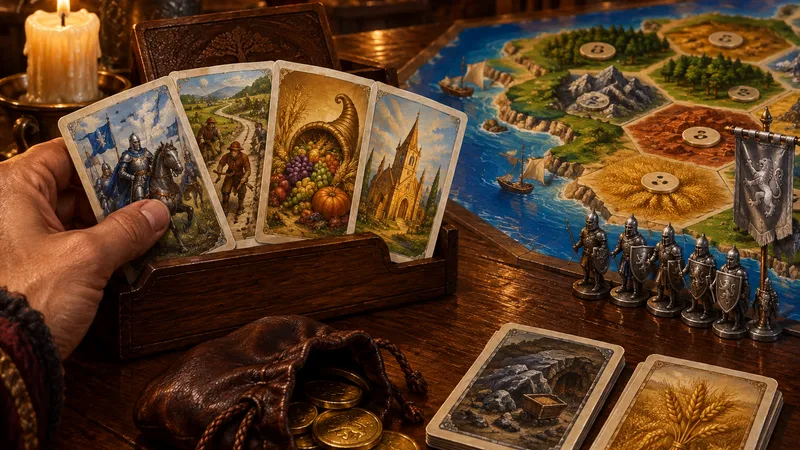
With 14 knights in 25 cards, each card you draw from a fresh deck is a knight 56% of the time and a victory point 20% of the time. Largest Army needs 3 knights played, and on average that takes about 5 cards:
| Cards bought | At least 3 knights | At least 1 victory point |
|---|---|---|
| 3 | 16% | 50% |
| 4 | 40% | 62% |
| 5 | 62% | 71% |
| 6 | 79% | 78% |
| 7 | 90% | 84% |
| 8 | 96% | 88% |
Our development cards guide covers when to play each one.
Using the numbers at your next game
- Count pips, not hexes. Three hexes on 2, 12 and 3 are worth less than one hex on 6.
- Spread your numbers. Two settlements that share no numbers produce on more rolls, so you wait less between cards.
- Don’t sit only on red. The robber goes where the pips are.
- Total around 20 pips for your two starting settlements on a normal board. Our 10,000-game study found the most pips don’t always win, but very few pips rarely do.
Count the pips on a fair board
A free account opens this exact board against three bots.
Questions people ask
What do the dots mean on Catan numbers?
The dots, called pips, count how many of the 36 two-dice results roll that number. A 6 or 8 has 5 dots, a 2 or 12 has 1. More dots means the hex produces more often.
Why are 6 and 8 red in Catan?
They are the most likely numbers after 7, rolling 5 times in 36 each. Since 7 produces nothing, 6 and 8 are the best numbers on the board, and the 5th edition rules say two red numbers must not sit next to each other on a random board.
How many knights are in a Catan deck?
The base game deck has 14 knights in 25 development cards. The 5–6 player extension deck has 20 knights.
How many development cards are in Catan?
25: 14 knights, 5 victory point cards, 2 road building, 2 year of plenty (Invention in the 6th edition) and 2 monopoly.
How many resource cards are in Catan?
95, which is 19 of each of the five resources.
How many points do you need to win Catan?
10 victory points, in the base game with 3 or 4 players and in the 5–6 player extension.
How many settlements, cities and roads does each player get?
Each player has 5 settlements, 4 cities and 15 roads.
Sources
Read on 15 November 2026:
Keep reading
 How to set up a Catan board for 3–6 players
 Balanced dice vs real dice: what changes
 Catan development cards: the odds and when to buy
Play a fair board now
Hearthsea is free to play: Classic and Seafarers on every island, against bots or online with friends, with no daily limit. Highlands, Skyfarers, The Spice Road and Cities & Knights cost $4.99 a month each, or $9.99 a month for all four, and every account gets one free game of each a day. This button opens a board the board generator dealt fair, with no red numbers touching.
CATAN is a registered trademark of Catan GmbH. Hearthsea is an independent game and is not affiliated with, endorsed by or sponsored by Catan GmbH or its publishers. Other game names belong to their owners and are used here only to describe and compare.