We simulated 10,000 games of Catan. Going first helps, and wool is the resource to skip.
We had Hearthsea’s Veteran bots play 10,000 four-player games on the standard island. The first player won 27.6% of them, against an even 25%. Starting without ore cut a player’s wins to 17.7%, while starting without wool raised them to 34.4%. The player with the most starting pips won only 24.8% of games.

How we ran it
Every game here was played start to finish by Hearthsea’s rules engine, the same one you play on.
- 10,000 four-player games and 5,000 three-player games on the standard island, with a freshly dealt board each game, all played to a winner at 10 points.
- Veteran bots in every seat, so every player had the same skill. Whatever separates winners from losers here is the position, not the player.
- Normal dice, two of them, fair. Each game has a recorded seed, so any of them can be replayed.
One limit to keep in mind: our bots lean on roads and cities and rarely chase the largest army, so we leave the road and army numbers out. What follows is about the start of the game, where the bots place the way strong players do.
Going first is worth about three points of win rate
With four equal players, each should win 25% of games. The first player won 27.6%; the other three won between 23.9% and 24.4%. With three players the first seat won 35.0% against an even 33.3%.
The edge is real but small: about one extra win in every 39 games. It comes from the first pick of the island and the first roll. The snake draft, where the last player places twice in a row, gives some of it back but not all.
The most pips don’t win
Pips, the dots under a number, count how often it rolls. Most guides tell you to add them up and take the biggest total. In our games the player who started with the most pips won only 24.8% of the 7,008 games that had one clear leader, about what chance gives.
The reason is that strong players all find good numbers: our bots started with 20 pips on average, and most were within a pip or two of each other. Among good starts, two or three pips decide little. Which resources those pips land on decides much more.
Skip wool, never skip ore
This is the strongest result in the data. A player whose starting settlements touched no ore won 17.7% of games, the worst of any gap. No wood was next at 19.5%, then no brick at 22.4%. Starting without grain cost almost nothing (24.2%).
Starting without wool did the opposite: those players won 34.4% of games. Wool buys settlements and development cards, but you need little of it, it is the easiest card to get in trade, and the pips you don’t spend on pasture go to ore, wood or brick, which you can’t do without. The three-player games agree: no ore won 22.4% and no wool 40.9%, against an even 33.3%.
Ore and grain beat wood and brick, and both beat neither
We sorted every start by where its pips fell. Starts with at least half their pips on ore and grain, the city route, won 29.5%. Starts leaning on wood and brick, the road and settlement route, won 25.7%. Starts that leaned on neither won only 22.3%.
So commit to a plan. Our winners built 3.8 cities on average, and cities made up about 75% of their points; ore and grain are what cities cost.
Touch all five resources if you can, and a harbor helps
| Starting position | Players | Won |
|---|---|---|
| All five resources | 22,354 | 26.3% |
| Four resources | 16,914 | 23.3% |
| On a harbor | 7,576 | 28.5% |
| Not on a harbor | 32,424 | 24.2% |
| Two 6s or 8s | 19,869 | 25.7% |
| One 6 or 8 | 18,700 | 24.3% |
Touching all five resources was worth three points over four. A starting settlement on a harbor was worth four, which is more than most players give harbors credit for. Having a second 6 or 8 was worth little once the rest of the start was good.
How long the games ran
The median four-player game lasted 17 rounds (69 rolls); one in ten ended by round 13 and one in ten went past 22. A 7 came up 11.4 times a game, exactly the one roll in six the dice promise. Three-player games took more rounds, 21, though each round is a turn shorter.
The games were closer than they feel at the table: the runner-up finished on 7.6 points on average.
What to do with this at your next game
- Take ore. If your first settlement doesn’t touch ore, your second one should.
- Don’t chase wool. Take it if it comes with a great number, and trade for the rest.
- Pick a route. Ore and grain for cities, or wood and brick for roads and settlements, beats a little of everything.
- Look at the harbors before you look at the third pip.
- If you go first, you have a small edge. Take the best spot on the board, not the cleverest.
Our strategy guide covers the rest of the game, and the balanced board guide covers placing on a board that is fair to begin with.
Questions people ask
Does going first matter in Catan?
A little. In 10,000 simulated four-player games between equal bots, the first player won 27.6% against an even 25%, about one extra win in 39 games.
What is the best resource in Catan?
Ore, by our data. Players who started with no ore won 17.7% of four-player games, the biggest drop of any resource. Ore and grain openings won 29.5%.
What is the worst resource in Catan?
Wool. Players who started without wool won 34.4% of four-player games, more than any other start, because wool is easy to trade for and needed least.
Do pips matter in Catan?
Less than you think between good starts. The player with the most starting pips won 24.8% of four-player games, close to chance, because strong players all start within a pip or two.
Is ore and wheat better than wood and brick?
In our simulation, yes: 29.5% against 25.7%. Both beat a start that leaned on neither, at 22.3%.
Are harbors worth it at the start?
Yes. Players who started on a harbor won 28.5% of four-player games against 24.2% for those who didn’t.
How many turns is a game of Catan?
The median was 17 rounds, or 69 rolls, in our four-player games, and 21 rounds with three players.
Can I check the data?
Yes. Every game used a recorded seed and Veteran bots in every seat, so each can be replayed in Hearthsea’s engine. The dataset is free to cite.
Sources
All numbers come from our own simulation, run on 18 October 2026 with Hearthsea’s rules engine: 10,000 four-player and 5,000 three-player games. For comparison, earlier simulations of the base game:
Keep reading
 How to win at Catan-style games: a strategy guide
- Balanced boards, fair setups and starting spots
 Balanced dice vs real dice: what changes
Play the bots that played these games
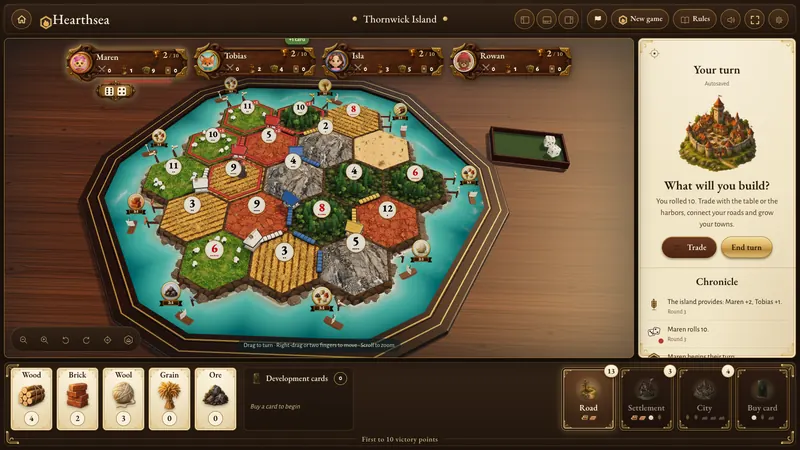
Hearthsea is free: every mode and every island, bots, online rooms with friends and quick match, with no daily limit. Seat three Veterans, skip the wool, and see if it works for you.
Hearthsea is free: every mode and every island, bots, online rooms with friends and quick match, with no daily limit. Seat three Veterans, skip the wool, and see if it works for you.
CATAN is a registered trademark of Catan GmbH. Hearthsea is an independent game and is not affiliated with, endorsed by or sponsored by Catan GmbH or its publishers. Other game names belong to their owners and are used here only to describe and compare.