Catan trading rules: the bank, ports and other players
In Catan, only the player whose turn it is can trade. They can trade with any other player, and the others may not trade among themselves. They can also trade with the bank at 4 of one resource for 1 of another, or at 3:1 or 2:1 through a harbor they have built on. Giving cards away, trading matching cards and trading development cards are all against the rules.

The trading rules in one list
Every trading argument at a Catan table comes back to one rule: the player whose turn it is must be part of the trade.
The 6th edition rulebook (2025) says it in two sentences: “You may trade freely with other players and the supply to get the resources you need to build. During your turn, other players may only trade with you, not with each other or with the supply.” The 5th edition almanac lists the rest:
- You may trade as long as you hold resource cards, as many times as you like on your turn.
- If the active player doesn’t trade, nobody trades.
- Between your turns you may trade only with the player whose turn it is.
- You may not trade with the bank on another player’s turn.
- You may not give cards away.
- You may not trade development cards.
- You may not trade like for like, such as 2 wool for 1 wool.
The 6th edition calls the bank “the supply” and harbors “ports”. The rules are the same.
Trading with other players
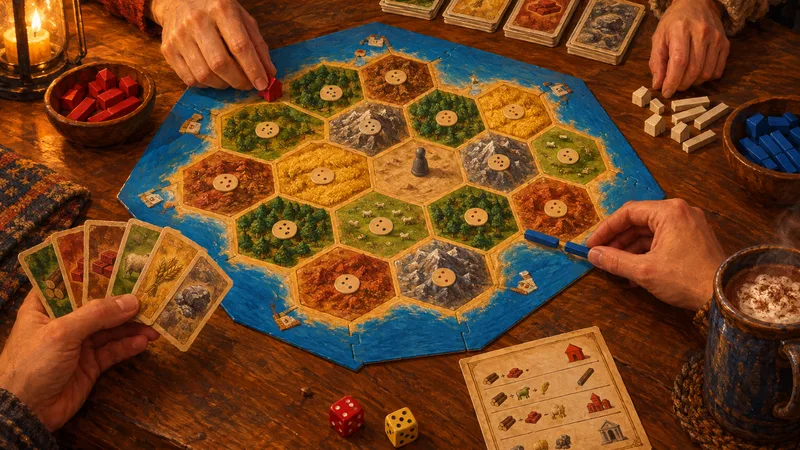
On your turn you announce what you want and what you’ll give. Anyone can answer with a counteroffer. A trade can be uneven: two lumber and an ore for one brick is allowed, as long as both sides give at least one card.
When it isn’t your turn, you can still offer the active player a deal. The 5th edition tactics section encourages it: “Even if it is not your turn, you should offer trades to the current player!” What you can’t do is trade with the player sitting next to you while somebody else is taking a turn.
The catan.com FAQ settles four common disputes:
| Question | Answer |
|---|---|
| On player A’s turn, may players B and C trade with each other? | No. B and C each trade with A instead. |
| May I give away cards, or pay for a favour such as “don’t rob me”? | No. A trade always means giving and taking resources. |
| May I trade in secret? | No. |
| May I trade on credit, a card now for a card later? | No. |
Promises are a different matter. You can say “I won’t put the robber on you if you trade with me”, but nothing in the rules makes anyone keep it.
Trading with the bank: 4:1, 3:1 and 2:1
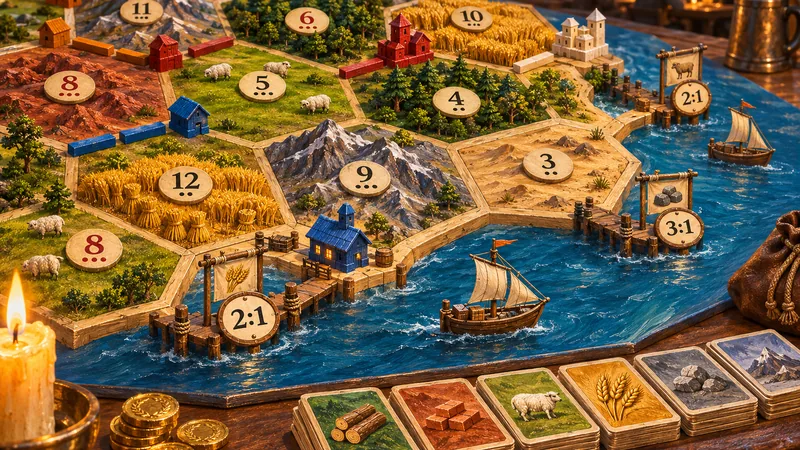
Maritime trade needs no other player. On your turn, after you roll, you can always put 4 cards of one resource back in the bank and take 1 card of any other resource. A harbor improves the rate, but only if you have a settlement or city on it:
| Where you trade | Rate | What it takes |
|---|---|---|
| The bank | 4:1 | 4 of the same resource for 1 of another. Always allowed. |
| A 3:1 harbor | 3:1 | 3 of any one resource for 1 of another. |
| A 2:1 harbor | 2:1 | 2 of the resource shown on the harbor for 1 of another. Other resources still trade at 4:1 (or 3:1 if you hold a 3:1 harbor too). |
A 2:1 harbor works in multiples: with the ore harbor you can trade 4 ore for 2 cards of your choice. It never helps with other resources. The almanac is blunt: a special harbor “does not permit you to trade any other resource type at a more favorable rate (not even 3:1)!”
You can’t use an opponent’s harbor, and the robber standing on a harbor’s hex doesn’t close it. For when a harbor pays for itself, see our ports guide, which tested 2:1 and 3:1 starts over 10,000 games.
When you can trade in a turn
Trading comes after the roll. In the 6th edition a turn has a production phase (roll and collect) and an action phase where you trade, build and play a card “in any order”. The 5th edition keeps trading and building as separate steps, with a combined trade-and-build phase offered as a variant.
- Before rolling: no trades. You may play a development card such as a knight before rolling, which is a different thing.
- After a 7: deal with the 7 first. The FAQ says you can’t trade “to reduce the number of your resources to seven or fewer before resolving the consequences of the ‘7’”.
- The turn you build on a harbor: if your group plays separate trade and build phases, the harbor works from your next turn. With a combined phase it works at once.
Trading with 5 or 6 players
This is where the two editions differ most. The 5th edition 5–6 player extension added a special build phase between turns, and during it nobody could trade at all, not even with the bank.
In 2021 catan.com replaced that with the paired-players rule, and the 6th edition prints it: “player 2 takes an Action phase with one restriction: Player 2 may not trade with other players.” So in a 6th edition 5–6 player game, the second player of the pair can trade with the bank and their harbors on someone else’s turn. That is the one official case of off-turn bank trading, and it may be why some groups think bank trades are allowed any time.
Two questions the rules don’t answer
Can you trade with two players at once? No rule covers a three-way deal. What the rules do say: the active player can make as many trades as they like, and the other two may not trade with each other. So two separate trades in a row are fine. A single deal in which the other two also swap cards between themselves is not.
When does a lopsided trade count as giving cards away? The rules ban only two things: getting nothing back, and swapping a resource for the same resource. Five cards for one is legal. Many groups still frown on a player who is out of the running “trading” a whole hand to a friend, and that is a table call, not a rule.
How trading works on Hearthsea
Hearthsea follows the official rules. Trades open after you roll. Every trade has to include the player whose turn it is, both sides must give at least one card (“no gifts”), and you can’t swap a resource for the same one. The bank and harbor rates are 4:1, 3:1 and 2:1 as above, and the bank never runs out. In games of five or six, the second player of each pair trades with the bank only, as in the paired-players rule.
Practise trading on a fair board
A free account opens this board against three bots that trade back.
Questions people ask
Can you trade in Catan when it’s not your turn?
Only with the player whose turn it is. You can offer them a deal or accept theirs, but you can’t trade with anyone else, and you can’t trade with the bank until your own turn.
Can you trade with the bank on someone else’s turn?
No, not in a 3–4 player game. The one exception is the 6th edition 5–6 player rule, where the second player of each pair may trade with the bank but not with other players.
Can you trade before rolling the dice?
No. Trading happens after the roll. You may play a development card such as a knight before you roll, but trades wait until the dice are down.
Can you give away cards in Catan?
No. Both rulebooks forbid giving cards away, and the catan.com FAQ adds that you can’t pay for favours with them either. Every trade must have cards moving in both directions.
Can you trade development cards?
No. The rules say you may not trade or give away development cards. Only resource cards are traded.
Can you trade in Catan without a port?
Yes. The 4:1 trade with the bank is always available on your turn, whether or not you have a settlement or city on a harbor.
Can someone else use my port?
No. A harbor’s rate applies only to the player who has a settlement or city on it. Everyone else trades with you directly or uses the 4:1 bank.
Can two players trade with each other on my turn?
No. The catan.com FAQ calls it a triangular trade and forbids it. Each of them can trade with you instead.
Can you trade on credit or for future cards?
No. The official FAQ says trades on credit aren’t allowed. You can promise things, but a promise isn’t binding under the rules.
Can you trade 3 ore for 1 ore?
No. Trading matching resources counts as giving cards away, which the rules forbid. You must get a different resource back.
Can you trade to get under 8 cards when a 7 is rolled?
No. The FAQ says you resolve the 7 first. You can’t trade to bring your hand down before you discard.
Sources
Read on 19 November 2026 (quotes from the rulebook PDFs and the catan.com FAQ):
Keep reading
 Catan ports: the rules, and is a 2:1 worth it?
 Starting settlements in Catan: the rules and where to place them
 How to play Catan: rules for beginners in 5 minutes
Trade with bots that trade back
Hearthsea is free to play: Classic and Seafarers on every island, against bots or online with friends, with no daily limit. Highlands, Skyfarers, The Spice Road and Cities & Knights cost $4.99 a month each, or $9.99 a month for all four, and every account gets one free game of each a day. This button opens a fair board against three bots that answer your offers and make their own.
CATAN is a registered trademark of Catan GmbH. Hearthsea is an independent game and is not affiliated with, endorsed by or sponsored by Catan GmbH or its publishers. Other game names belong to their owners and are used here only to describe and compare.