Starting settlements in Catan: the rules and where to place them
Each player places two settlements and two roads before the first roll, in snake order: first player to last, then last back to first. Every settlement keeps the distance rule. You take one card for each hex touching your second settlement. In our 10,000 simulated games, starting without ore cost the most: those players won 17.7% against a fair share of 25%.

The placement rules, step by step
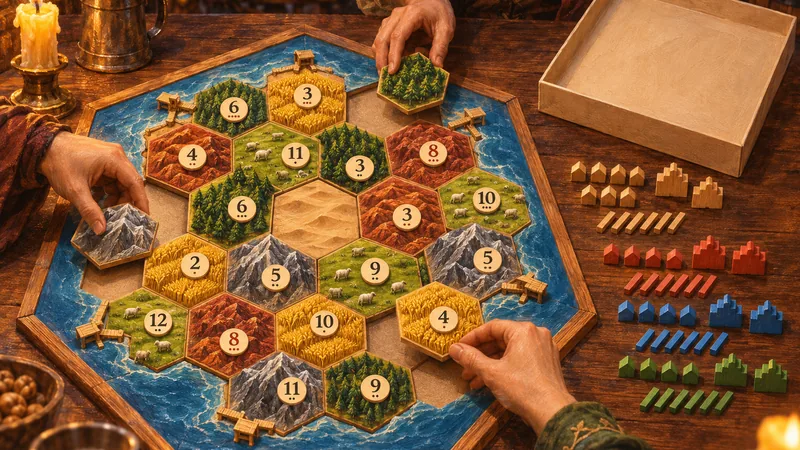
The setup is the only time in Catan you build for free, and the rules for it fit in five steps.
- Pick the first player. Everyone rolls; the highest roll goes first.
- Round one: in turn order, each player places 1 settlement on any empty corner and 1 road touching it.
- Round two, in reverse: the last player places again first, and the order runs back to the first player. Each places a second settlement and a road touching that new settlement.
- Collect: each player takes 1 resource card for every hex touching their second settlement.
- Start: the first player, who placed last, rolls the dice.
The 5th edition almanac adds that the second settlement “doesn’t have to connect to the first settlement,” and that the second road “must attach to the second settlement (pointing in any of the 3 directions).” The 6th edition (2025) keeps every one of these rules.
The distance rule during setup
The distance rule applies from the first placement. In the 6th edition’s words: “When placing a settlement, stay two edges away from all other settlements.” No settlement may sit on a corner next to another one, yours or anyone else’s. A corner counts as taken the moment someone places there; the FAQ confirms nobody can reserve a spot.
Your starting road doesn’t need to lead anywhere useful, but it is the only free road you get. Point it at the corner you want to expand to.
Why the order snakes
The reverse order evens out the picks. In a four-player game the first player gets the best corner on the board but waits for six other placements before their second. The last player gets two picks back to back and can plan them as a pair.
Going first is still an edge, and it comes mostly from rolling first. In our simulated four-player games the first player won 27.6% of the time, against 25% for a fair share. The other three seats were close to even.
Can you start on a harbor?
Yes. The catan.com FAQ answers the question directly: “May I build a settlement at a harbor during the set-up phase?” “Yes. This is not contradicted by the rules.” Plenty of tables still argue it, because the almanac never mentions harbors in the setup section.
Whether you should is another question. Harbor corners touch only one or two land hexes, so they cost pips. In our simulated games, players with a harbor in their starting pair won 28.5%, against 24.2% for those without. It pays when the harbor matches a resource you’ll produce a lot of. Our ports guide breaks it down by harbor type.
What 10,000 games say about where to place
We ran 10,000 four-player games between Hearthsea’s Veteran bots, each on a freshly dealt fair board, and recorded every player’s two starting settlements. Three findings stand out.
- Ore is the hardest gap to fill. Players who started with no ore won 17.7% of the time. Ore buys cities and development cards, and boards have only three mountains. Wool is the one you can skip: players who started without it won 34.4%.
- Pips matter less than you’d think. Players with 23 or more pips across both settlements won 28.0%; players with 18 or fewer won 23.5%. A spread of numbers helped about as much: players touching all five resources won 26.3%.
- City starts beat road starts. Players whose start leaned on ore and grain won 29.5%; lumber-and-brick starts won 25.7%.
Our method and the full numbers are in we simulated 10,000 games of Catan. Bots aren’t people, and they trade differently, so read these as tendencies.
Brick first, or ore first?
The official advice and the champions disagree. The 5th edition tactics page says: “Brick and lumber are the most important resources at the beginning of the game… You should try to place at least 1 of your first settlements on a good forest or hills hex.”
Bo Peng, the 2021 US national champion, starts somewhere else. Asked what he looks for, he said he checks first for “a 6/5/9 Ore/Wheat/Sheep spot, which is the equivalent of pocket aces in poker,” and if there isn’t one, for a spot that guarantees a safe second pick. He also told Colonist that about half of a game is decided by the starting placement.
Our data sides with the champion: ore-and-grain starts won more often than lumber-and-brick starts. The publisher’s advice is aimed at a first game, where getting roads and settlements down quickly keeps new players in it.
- First pick: the strongest corner for the plan you want. If an ore-grain-wool corner on good numbers exists, take it.
- Second pick: fill the gaps, especially ore, and remember it pays out your starting hand.
- Leave room. Point both roads toward open corners before someone closes them off.
Try your opening on a fair board
A free account opens this board against three bots. The snake order is the same.
Setup in 5–6 players and Cities & Knights
- 5–6 players: the same snake order with more players. You still collect from the settlement you placed last.
- Cities & Knights: your second placement is a city, not a settlement, and you collect from the city: “You get 1 resource for each terrain that your city is adjacent to.” That makes the second pick worth even more.
- A first game: both editions print a fixed beginner setup with the starting pieces drawn on the board, so new players can skip placement.
Hearthsea uses the same snake order, distance rule and second-settlement payout, with a city as the second piece in Cities & Knights. If you’d rather practise on a fresh board each time, our board generator deals fair ones.
Questions people ask
Do you get resources from the first or second settlement?
From the second. Each player takes 1 resource card for each hex touching the settlement they placed in round two. The first settlement pays nothing until the dice start rolling.
Can you place a starting settlement on a port?
Yes. The catan.com FAQ says building on a harbor during setup is allowed. Harbor corners usually touch fewer land hexes, so you give up some production for the better trade rate.
Does the second settlement have to connect to the first?
No. The 5th edition almanac says it can go on any empty corner that keeps the distance rule. Only the second road must touch the second settlement.
Why does the placement order reverse in Catan?
To even out the picks. The first player gets the best spot but places their second settlement last, and the last player places twice in a row.
Who rolls first after setup?
The first player, who placed the first settlement and the very last one. In the 6th edition the first player is whoever rolled highest before setup.
Does the distance rule apply during setup?
Yes. Every settlement, including the starting ones, must be at least two edges away from every other settlement on the board.
Can the starting road point in any direction?
Yes. Each starting road must touch its settlement, and it can point along any of the three edges from that corner.
What is the best starting spot in Catan?
A corner on three different resources with high numbers, ideally with ore. In our simulations, players who started without ore won 17.7% of games against a fair share of 25%.
How many pips should your starting settlements have?
Around 20 across both is typical on a fair board. More pips help a little; covering all five resources and ore helps as much.
Is going first in Catan an advantage?
A small one. In 10,000 simulated four-player games the first player won 27.6% of the time, against a fair share of 25%.
Sources
Read on 19 November 2026; simulation data from Hearthsea’s own runs:
Keep reading
 How to set up a Catan board for 3–6 players
 Catan numbers: pips, odds and why 6 and 8 are red
 Catan trading rules: the bank, ports and other players
Practise your opening
Hearthsea is free to play: Classic and Seafarers on every island, against bots or online with friends, with no daily limit. Highlands, Skyfarers, The Spice Road and Cities & Knights cost $4.99 a month each, or $9.99 a month for all four, and every account gets one free game of each a day. This button opens a fair board where the snake draft runs exactly as above.
CATAN is a registered trademark of Catan GmbH. Hearthsea is an independent game and is not affiliated with, endorsed by or sponsored by Catan GmbH or its publishers. Other game names belong to their owners and are used here only to describe and compare.