How to play Catan: the rules for beginners in 5 minutes
In Catan, 3 or 4 players collect wood, brick, wool, grain and ore from hexes whose number matches the dice roll, trade them, and spend them on roads, settlements and cities. A settlement is worth 1 point and a city 2. The first player to reach 10 victory points on their own turn wins.

The goal: 10 victory points
Catan is a race to 10 victory points. You score them by building, and you build with resources the island produces when the dice roll its numbers.
- Settlement: 1 point.
- City: 2 points (it replaces a settlement).
- Longest Road: 2 points for the first unbroken road of 5 or more pieces, held while it stays the longest.
- Largest Army: 2 points for the first player to have played 3 Knight cards.
- Victory Point cards: 1 point each, kept hidden until you win.
You can only win on your own turn, the moment you reach 10.
The board and the five resources
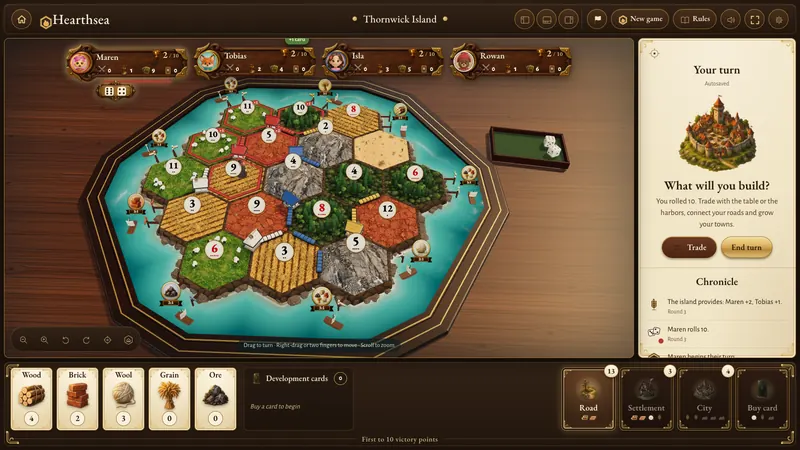
The island is 19 hexes: 4 forests (wood), 4 pastures (wool), 4 fields (grain, called wheat in the 6th edition), 3 hills (brick), 3 mountains (ore) and one desert, which produces nothing. Each hex except the desert has a number token from 2 to 12.
The dots under each number show how likely it is: 6 and 8 have five dots and come up most, 2 and 12 have one dot and come up least. That’s why 6 and 8 are printed in red.

Setting up: two settlements and two roads
Each player places two settlements, each with a road touching it. The order snakes: player 1, 2, 3, 4 place one settlement and road each, then 4, 3, 2, 1 place their second. Your second settlement pays out at once: take one resource for each hex it touches.
Two placement rules apply all game: a settlement goes on a corner where hexes meet, and no settlement may be on a corner next to another settlement (the distance rule). For a first game, the rulebook’s beginner layout is a fine start; after that, a random board keeps it fresh.
A turn: roll, trade, build
- Roll the dice. Every hex with that number produces: each player with a settlement on it takes one of its resource, and a city takes two. Everyone collects, not just the player who rolled.
- Trade. Swap cards with other players on any terms you agree, or trade with the bank.
- Build. Spend resources on roads, settlements, cities or development cards, as many as you can pay for.
Then the dice pass to the left. If the roll is a 7, nobody produces and the robber moves instead; our robber rules post covers that turn in full.
What everything costs
| Build | Costs | Gives |
|---|---|---|
| Road | 1 wood, 1 brick | Reach new corners; counts for Longest Road |
| Settlement | 1 wood, 1 brick, 1 wool, 1 grain | 1 point, 1 resource per roll of its hexes |
| City | 2 grain, 3 ore | 2 points, 2 resources per roll |
| Development card | 1 wool, 1 grain, 1 ore | A Knight, a Victory Point or a one-off bonus |
Trading: players, the bank and harbors
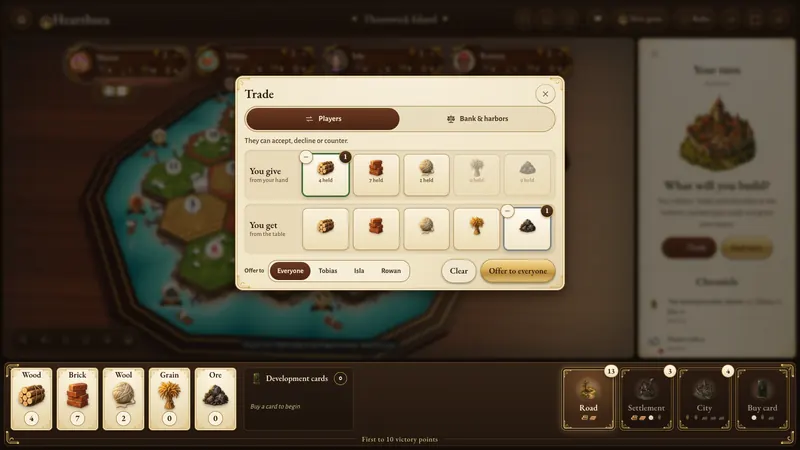
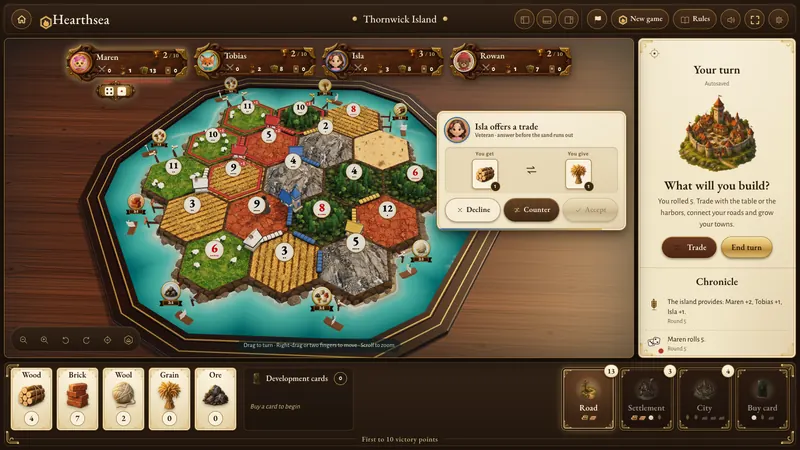
On your turn you can trade with anyone at the table; other players can only trade with you, not with each other. With the bank, four of one resource buy one of any other. A settlement on a harbor makes it cheaper: a 3:1 harbor trades three of anything for one, and a 2:1 harbor trades two of its own resource for one.
Seven tips for your first game
- Count the dots. Put your first settlements on corners whose hexes add up to the most dots.
- Spread your numbers. Two settlements on the same numbers starve you when those numbers don’t come.
- Get brick and wood early. Roads and settlements need them, and they run out first.
- Turn settlements into cities. A city doubles a corner’s income for one spot on the board.
- Keep 7 cards or fewer. An eighth card risks losing half your hand on a 7.
- Trade every turn. A fair trade that builds something now beats waiting for the dice.
- Watch the leader. Put the robber on their best hex and don’t trade them their last card.
When you’re ready for more, read our strategy guide.
Learn Catan online, free
The quickest way to learn is to play a game where the rules are enforced for you. Hearthsea’s free lessons teach Catan-style play one step at a time on a real board: the island and its numbers, placing your first settlements, rolling and the robber, building, trading, development cards, and Longest Road. Then play a game against Settler-level bots, which forgive mistakes, before you invite friends.
Open Play, make a free account with an email address or Google, and pick the lessons, or jump straight into Play solo.
Questions people ask
How do you win Catan?
Be the first to reach 10 victory points on your own turn. Settlements are worth 1, cities 2, Longest Road and Largest Army 2 each, and Victory Point cards 1.
How many players can play Catan?
The base game is for 3 or 4 players. The 5–6 player extension adds two more. Hearthsea seats 2 to 6.
How do you set up Catan for beginners?
Use the rulebook’s beginner layout, or place two settlements and two roads each in snake order (1-2-3-4, then 4-3-2-1). The second settlement pays one resource for each hex it touches.
What does each build cost in Catan?
A road is wood and brick. A settlement is wood, brick, wool and grain. A city is 2 grain and 3 ore. A development card is wool, grain and ore.
How long does a game of Catan take?
About 60 to 90 minutes with four players who know the rules. A first game takes longer.
Can you learn Catan online for free?
Yes. Hearthsea, a free Catan-style browser game, has step-by-step lessons and bots that forgive beginner mistakes.
Sources
Read on 3 November 2026:
Keep reading
 How to win at Catan-style games: a strategy guide
 Catan rules people get wrong
 Play a Catan-style game against AI bots
Learn it in your browser, free
Hearthsea is free to play: Classic and Seafarers on all 51 islands, against bots or online with friends, with no daily limit. Highlands, Skyfarers, The Spice Road and Cities & Knights are optional at $4.99 a month each, or $9.99 a month for all four, and every account plays one free game of each a day. Start with the free lessons, then a game against the bots.
CATAN is a registered trademark of Catan GmbH. Hearthsea is an independent game and is not affiliated with, endorsed by or sponsored by Catan GmbH or its publishers. Other game names belong to their owners and are used here only to describe and compare.