We dealt 10,000 random Catan boards: 84% put a 6 beside an 8
A fully random Catan board is rarely fair. Across 10,000 random deals of the 3–4 player board, 84.1% put a 6 next to an 8, 80.4% had a corner worth 13 pips or more, and only 0.1% met every fair-board rule. A board generator that searches for a fair layout finds one in about 2 tries.

How we dealt 10,000 boards
We took the pieces in the box and dealt them with no rules at all, the way most tables shuffle: terrain face down, number tokens in a pile, harbors on the frame.
Hearthsea’s board generator did the dealing, with its rules switched off: 10,000 boards for the base game’s 3–4 player island (19 hexes, 18 number tokens, 9 harbors) and 10,000 for the 5–6 player extension (30 hexes, 28 tokens, 11 harbors). Every deal used its own recorded seed, so any board can be dealt again. Then we checked each board against the house rules players argue about.
| Rule | 3–4 players | 5–6 players |
|---|---|---|
| A 6 or 8 touches another 6 or 8 | 84.1% | 95.5% |
| Two of the same number touch | 89.8% | 99.4% |
| A 2 touches a 12, or two of them touch | 30.9% | 74.6% |
| Three hexes of one terrain in a clump | 77.4% | 96.0% |
| One resource gets far better numbers than the rest | 77.8% | 50.1% |
| A corner worth 13 pips or more | 80.4% | 92.7% |
| Meets every rule of the Fair preset | 0.1% | 0.0% |
A pip is a dot under a number: how many of the 36 dice rolls hit it. A 6 or 8 has five, a 2 or 12 has one. A corner’s pips are the dots of the three hexes it touches.
Can 6 and 8 be next to each other in Catan?
By the rulebook’s own setup, no. The published rules lay the number tokens in a fixed spiral, and for a variable board they tell you to swap any red number that lands beside another red one. Shuffle the tokens without that check and the reds touch on 84.1% of 3–4 player boards and 95.5% of 5–6 player boards.
It matters because two touching reds make one corner worth 10 pips from those two hexes alone. Whoever sits there collects on 10 of every 36 rolls before the third hex counts. That is the board people remember losing on.
The corner that decides the game
On a random 3–4 player board the best corner averages 13.3 pips, and 80.4% of boards have a corner of 13 or more. The highest we saw was 15. Our Fair preset caps every corner at 12.
The surprise was the starting seats. When we let four players draft in the rulebook’s order (1, 2, 3, 4, then 4, 3, 2, 1), each taking the best corner left, the gap between the richest and poorest start averaged only 2.0 pips, and only 1.5% of boards left a gap above 4. The snake order evens things out more than people think. The hot corner still hurts, because the player who gets it can grow faster from it, and the 10,000 games our bots played show the first seat already wins 27.6% of four-player games against an even 25%.
Deal a fair board now
This is the generator. Pick the box you own, pick a preset, and deal. Every seat’s opening shows under the board, and the link deals the same board on anyone’s phone. When the board is set, open Lay it out and it calls the hexes out row by row, so nobody reads the layout off a screen held over the table.
The full page adds every house rule, printing, and a test that plays your board 48 times with bots and tells you whether any seat wins more than it should.
Which preset to pick
- Fair keeps reds apart, keeps the same number apart, stops three of one terrain clumping, gives every resource a fair share of the dice and caps any corner at 12 pips. It is the one for a family table.
- Tournament tight also keeps 2 and 12 apart, spreads each terrain out, caps corners at 11 and moves 2:1 harbors away from their own resource.
- Rulebook only keeps the reds apart, as the published variable setup does.
- Wild deals anything, harbors included. Our numbers above are what Wild gives you.
Strict rules are why shuffling by hand fails: only 0.1% of random deals meet the Fair preset. The generator searches instead of shuffling, placing each hex and token where the rules allow, and finds a Fair board in a median of 2 tries (9 at the slowest 5%).
5–6 players, Seafarers and Cities & Knights
Bigger boards are worse at random. On the 5–6 player board, 95.5% of deals put reds together and 99.4% put two equal numbers side by side. Not one of our 10,000 random 5–6 deals met every Fair rule.
The generator deals the 5–6 extension, Seafarers’ Heading for New Shores scenario for 3, 4 and 5–6 players (main island, small islands and open sea placed as the rulebook diagrams show), and Cities & Knights on the base boards, where it can also make sure ore, grain and wool each have a hex on a good number, since cities need all three.
Play the board you just dealt
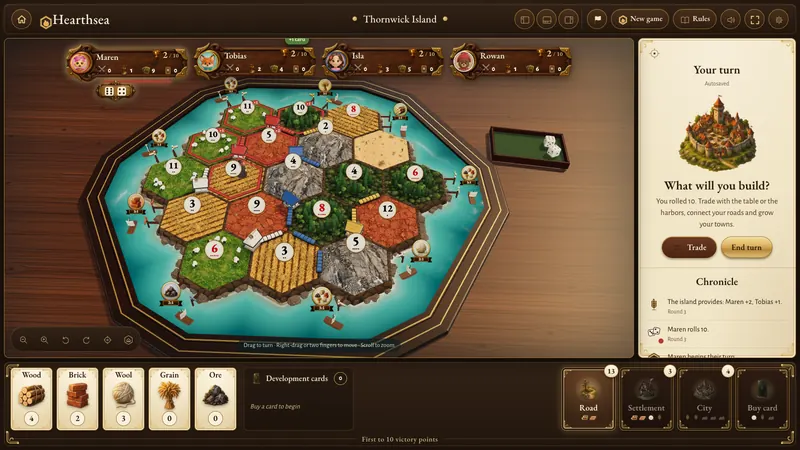
Every board ends with Play this island. It opens that exact layout in Hearthsea against three bots, free, in the browser. It is a quick way to see whether the seat you were dreading is really that bad, or to warm up on tonight’s board before friends arrive.
Questions people ask
Can 6 and 8 be next to each other in Catan?
Not under the rulebook’s variable setup, which swaps any red number placed beside another. A fully random shuffle puts them together on 84.1% of 3–4 player boards in our 10,000-deal test.
What is the best Catan board generator?
Pick one that deals from your box’s real pieces, checks house rules and shows each seat’s start. Hearthsea’s free generator also plays the board 48 times with bots to measure every seat, and walks you through laying it out.
How do you set up a fair Catan board?
Keep 6s and 8s apart, keep equal numbers apart, avoid three of one terrain in a clump, give each resource a fair share of pips and cap any corner at 12. Or deal one with the Fair preset.
How many pips is a good starting corner?
On a random board the best corner averages about 13 pips. A start of 10 to 12 pips per settlement is strong; under 8 means you need harbors or trades to keep up.
Does the generator work for Seafarers and 5–6 players?
Yes. It deals the 5–6 extension, Seafarers’ Heading for New Shores for 3, 4 and 5–6 players, and Cities & Knights on the base boards, from each box’s real piece counts.
Can I play the board online?
Yes. Every dealt board has Play this island, which opens that exact layout in Hearthsea against bots, free in your browser with no download.
Sources
Every number above comes from our own deals, run on 19 October 2026. For the published setup and what players ask:
Keep reading
 Balanced boards, fair setups and starting spots
 We simulated 10,000 games of Catan
- How to win at Catan-style games: a strategy guide
Deal it, then play it
Hearthsea is free: every mode and every island, bots, online rooms with friends and quick match, with no daily limit. Every board the generator deals can be played here.
Hearthsea is free: every mode and every island, bots, online rooms with friends and quick match, with no daily limit. Every board the generator deals can be played here.
CATAN is a registered trademark of Catan GmbH. Hearthsea is an independent game and is not affiliated with, endorsed by or sponsored by Catan GmbH or its publishers. Other game names belong to their owners and are used here only to describe and compare.