Ore-wheat-sheep strategy: does OWS really win at Catan?
Ore-wheat-sheep (OWS) is a Catan strategy that skips most roads and settlements and spends ore, wheat and wool on cities and development cards instead. In our 10,000 simulated four-player games, starts heavy in ore and grain won 29.5% of the time against a fair 25%. Pure OWS starts with almost no wood or brick won only 24.0%: the strong version keeps one source of wood and brick.

What is the ore-wheat-sheep strategy?
OWS trades the board for the deck: fewer roads, more cities and development cards.
The three resources in the name pay for the two things the strategy wants. A city costs 2 wheat and 3 ore; a development card costs 1 ore, 1 wheat and 1 wool. An OWS player starts on mountains, fields and pastures, upgrades settlements to cities early, and buys cards for knights (toward Largest Army) and hidden victory points.
It is the most talked-about plan in competitive play: YouTube videos on it run from “The Ore Wheat Sheep Strategy is BROKEN!!” to “Hybrid OWS (Strongest Strategy)”, the most watched of the lot at about 92,000 views when we checked.
What 10,000 games say about OWS
We went back to our 10,000-game study of Hearthsea’s strongest bots on fresh boards and sorted every player by their starting resources.
Ore and grain win: 29.5% across 10,284 starts. But the pure version, all-in on ore, wheat and wool with almost no wood or brick, won only 24.0% across 3,279 starts. The likely reason is room: without wood and brick you can’t build the third and fourth settlements that cities need.
How OWS players actually win
| Pure OWS winners | Road-heavy winners | All winners | |
|---|---|---|---|
| Cities | 3.88 | 3.54 | 3.77 |
| Settlements | 0.5 | 1.23 | 0.77 |
| Held Largest Army | 4.3% | 0.4% | 1.5% |
| Victory point cards | 0.24 | 0.07 | 0.12 |
OWS winners lean on cities: 3.88 on average, and ten times as often as road builders they also held Largest Army. One caution about our bots: they rarely chase Largest Army at all, so human OWS players who buy cards hard will see more of it than this table does.
The hybrid OWS that works
- First settlement: ore and wheat. A corner on a good mountain and a good field, ideally 6, 8, 5 or 9.
- Second settlement: wood or brick, plus wool. Enough road material for two more settlements, not a road race.
- Upgrade to cities early. Your first city doubles your best numbers.
- Buy development cards with the leftovers. Every 1 ore, 1 wheat and 1 wool you can’t use goes on a card. About 5 cards bring 3 knights on average; see the deck odds.
- Take a port if you can. A 3:1 or a wheat or ore 2:1 turns surplus into the wood you lack. Our ports study found port starts win more.
When OWS fails
- The robber camps on your mountain. All your plans run through ore; one blocked hex stalls the strategy.
- You’re boxed in. Road players take the corners you need for settlements three and four.
- Sevens eat your hand. OWS players hoard toward a city (5 cards). Over 7 cards on a 7 and you lose half.
- A small table. With three players there is more room, and road builders do well; the winner held Longest Route in 84% of our three-player games.
Try OWS on this board
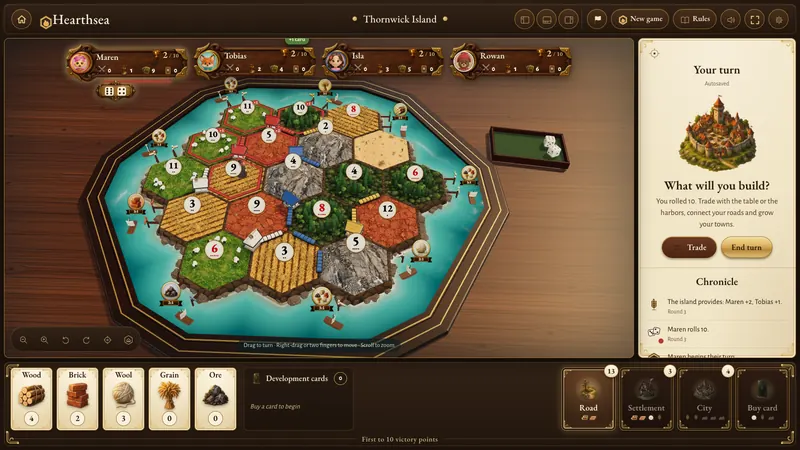
Look for the mountain-field corner. A free account opens this fair board against three bots.
Questions people ask
What is OWS in Catan?
Ore, wheat and sheep (wool): a strategy that builds cities and buys development cards instead of racing for roads and settlements.
Is ore-wheat-sheep the best Catan strategy?
Ore-and-grain heavy starts did best in our 10,000 simulated games, 29.5% against a fair 25%. Pure OWS with no wood or brick did worse, 24.0%. The winning version keeps some wood and brick.
What do you need for OWS in Catan?
A strong mountain and field, ideally on 6, 8, 5 or 9, some wool, and one modest source of wood or brick for two extra settlements.
How many development cards do you need for Largest Army?
Three knights. From a full deck, buying about 5 cards gives you 3 knights on average.
Does OWS work with 3 players?
Less well. A three-player board has more room, which favours players who expand with roads.
Sources
Read on 15 November 2026:
Keep reading
 How to win at Catan-style games: a strategy guide
 We simulated 10,000 games of Catan
 Catan development cards: the odds and when to buy
Find the OWS corner
Hearthsea is free to play: Classic and Seafarers on every island, against bots or online with friends, with no daily limit. Highlands, Skyfarers, The Spice Road and Cities & Knights cost $4.99 a month each, or $9.99 a month for all four, and every account gets one free game of each a day. The button opens a fair four-player board against three bots.
CATAN is a registered trademark of Catan GmbH. Hearthsea is an independent game and is not affiliated with, endorsed by or sponsored by Catan GmbH or its publishers. Other game names belong to their owners and are used here only to describe and compare.